Moving to Cyprus full-time or for part of the year
You may be thinking of spending just 60 days a year in Cyprus, or you may be ready to move here full-time. At the Meridian Relocation Desk, we start by talking through what you have in mind. If you’ll be dividing your time between countries, our tax advisers look at where you’ll spend the rest of the year, the home you plan to keep in Cyprus and the work or business you’ll do here. That helps us assess whether you qualify for Cyprus tax residency under the 60-day rule. We also look at your domicile history to advise you on Cyprus non-dom status.
Your dedicated immigration lawyer explains which residence arrangements apply to you and your family, what you can arrange from abroad and when you’ll need to be in Cyprus. If you’re setting up a Cyprus company, your lawyer works with our corporate and tax advisers to check how your role in the business fits your residence and tax plans. Before you decide how to pay yourself, we can use your expected salary and dividends to estimate how much you’d take home after Cyprus tax and contributions. If you’re moving with children, we can check which schools have places and arrange visits while you’re here.
The Meridian Relocation Desk
We start by asking about your nationality, whether you plan to work in Cyprus, whether permanent residency is your goal, and who will be moving with you. This helps our immigration lawyers provide personalised advice, identify the residence route that suits you and check what each family member needs to do. We explain which documents you’ll need and help you prepare them for your application.
Your dedicated immigration lawyer sets out what you can do before you travel, which appointments you need to attend in person and what you’ll need to complete after you arrive. When planning those dates, we take into account when your home in Cyprus will be available, when your children start school and any timing requirements our tax advisers identify.
Expertise behind your move to Cyprus
Our immigration lawyers work with our corporate lawyers, tax advisers and accountants. If you plan to run a business from Cyprus, for example, we look at whether your residence route allows you to do that work and how your role in the business affects your tax position. If members of your family have different nationalities, we check which residence and work rules, including any requirements for work permits, apply to each of you.
If you already have a tax adviser abroad, we work directly with them on questions that affect you in both countries. These might include how dividing your time between the two countries affects your tax residence, or how each country treats salary or dividends from your company.
How we plan your move to Cyprus
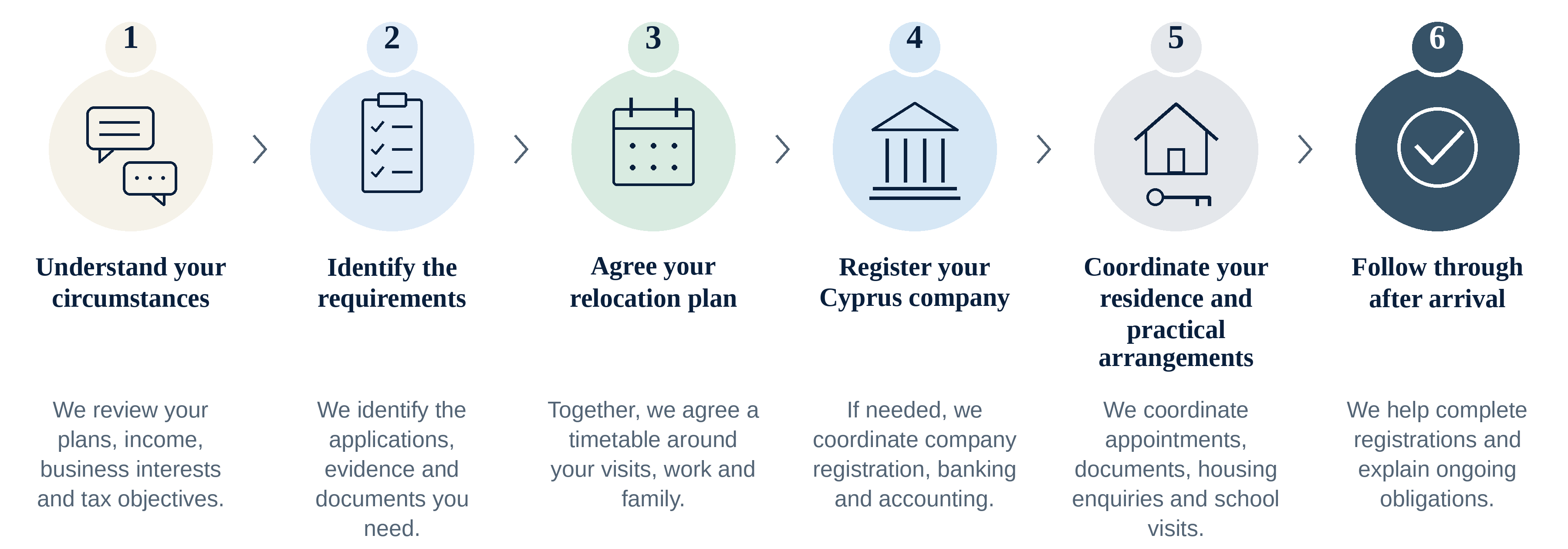
1. Understand your circumstances.
We start with what you want from the move, including any significant tax incentives or other tax benefits Cyprus offers that you’d like to explore. We ask where you’re currently tax resident, how much of the year you’d like to spend in Cyprus and where your income comes from. We look at those details alongside your business interests to assess whether you could qualify for Cyprus tax residency. We review your domicile history separately to advise you on non-dom status.
2. Identify the requirements.
Our immigration lawyers check what you and any family members joining you need in order to live and, where relevant, work in Cyprus. We set out which applications or registrations each of you needs, what evidence to provide and which documents need to be translated or certified. We also identify any tax questions to raise with your adviser abroad.
3. Agree your relocation plan.
Together, we agree a timetable that shows who will handle each step. You’ll know what you can do from abroad and which appointments you need to attend in Cyprus. We plan those appointments around your visits, work commitments and, if you’re moving with children, school dates.
4. Register your Cyprus company.
If you plan to set up a Cyprus company, our corporate lawyers advise you on how to structure it, who will own it and how it will be managed, taking account of your business activities and personal tax objectives. We register the company and coordinate its registered office, company secretary and tax registration. We also help you apply for a business bank account and set up accounting and, if needed, payroll.
5. Coordinate your residence and practical arrangements.
Your dedicated immigration lawyer arranges appointments, follows up on outstanding documents and works with our tax advisers on any tax applications you need. If you’re looking for a home or a school place, we can put you in touch with property professionals and arrange school visits. Your lawyer keeps you updated and lets you know when a decision or document is needed from you. English is widely spoken in Cyprus and commonly used in business and the public sector, which can help with communication as you make these arrangements.
6. Follow through after arrival.
Once you arrive, we help you complete any outstanding registrations. Depending on what you need, we can also help with utilities, healthcare enquiries and school enrolment. If you’re establishing Cyprus tax residency, we explain how to keep a record of your travel days and what ongoing tax obligations apply to you, including where you qualify for non-dom status. Our corporate and accounting teams can continue to look after your Cyprus company, and you can return to your usual contact if your plans change.
Relocation support built around your plans
Cyprus Residence Permits and Immigration
If you’re moving for tax reasons, you’ll also need to understand the immigration rules and other local regulations that apply to your stay. Our immigration lawyers look at how long you plan to spend in Cyprus, what you’ll be doing here and how often you expect to travel abroad. Our tax advisers assess your eligibility for Cyprus tax residency and, separately, for non-dom status.
If you’re an EU (European Union) national, we can help you apply for the registration certificate commonly known as the Yellow Slip. We explain which documents you need, help you gather them and arrange your appointment. If family members, including non-EU citizens, are joining you, we check which registration or residence requirements apply to each person.
If you’re a non-EU national, we look at whether a temporary visitor residence permit, commonly known as the Pink Slip, suits your plans. We review where your income comes from, whether you intend to work in Cyprus and how much time you expect to spend abroad. If the visitor route is suitable, we help you prepare your application for the Migration Department (formerly the Civil Registry and Migration Department), including evidence of your income, accommodation and health insurance.
Eligible non-EU nationals can apply for permanent residency by purchasing a qualifying house or apartment from a developer for at least €300,000 plus VAT. The property must be a first sale. This route also requires secure annual income of at least €50,000 from abroad, higher income for accompanying dependants and compliance with the other eligibility conditions.
Before you book travel, we explain any conditions your residence route places on time spent outside Cyprus. We also flag residency permit application deadlines and any renewals you’ll need to plan for.
Explore Cyprus immigration services
Cyprus Tax Residency and Non-Dom Status for part-year and full-time stays
If you’re considering the 60-day rule, we start by looking at how many days you expect to spend in Cyprus and in each other country over the calendar year. We also review the permanent home you plan to own or rent in Cyprus and any business you’ll run, employment you’ll take up or office you’ll hold here. We assess non-dom status separately, looking at your domicile history and explaining what non-dom treatment would mean for income such as dividends and interest. We coordinate your tax registrations in Cyprus and work with your adviser abroad on any continuing obligations there.
Cyprus non-dom status can exempt eligible tax residents from Special Defence Contribution on dividends and interest, generally for up to 17 years. Your domicile and previous Cyprus tax residence affect eligibility and the available exemption period. From 2026, eligible individuals may extend the exemption for up to two additional five-year periods by paying €250,000 per period.
Explore Cyprus non-dom services

Finding and securing a home
Before you pay a deposit or sign a rental or purchase agreement in Cyprus, our lawyers can review the terms with you.
If you’re renting, it’s worth checking who pays the building’s common expenses, who is responsible for repairs and whether you can recover your deposit if your plans change.
If you are buying, newly built homes in Cyprus are generally subject to 19% VAT. A reduced 5% rate may apply to the eligible portion of a qualifying main and permanent residence, subject to the applicable size, value and eligibility rules and approval from the Tax Department.
If you’re still deciding where to live, the Meridian Relocation Desk can help you narrow down the areas that suit you and introduce you to local property professionals. If your children will be going to school here, we can check school availability in the areas you’re considering before you commit to a home.
Schools and family arrangements
Tell us your children’s ages, which curriculum you’d like them to follow and where you’re thinking of living. We can help you shortlist schools, contact them about available places and application dates, and arrange visits while you’re in Cyprus. If you’re choosing between two areas, we can plan the visits so you can try the morning school run before you decide where to live.
Private schools in Cyprus offer Cypriot, British and other international curricula, with options for teaching in English or Greek. If your child is already working towards IGCSEs, A levels or the International Baccalaureate, we can take that into account when putting together your shortlist. Each school makes its own admissions decisions.
Cyprus company formation as part of your relocation to Cyprus
If you’re setting up a company as part of your move to Cyprus, we’ll talk through what the business will do, who will own it and what your day-to-day role will be. The requirements for living and working here depend on whether you’re an EU or non-EU national. Your immigration lawyer at the Meridian Relocation Desk will explain which steps apply to you, taking into account the work you plan to do.
Our corporate and tax advisers will also help you work out how to pay yourself. If you expect to receive dividends, we’ll explain how Cyprus non-dom status would affect them if you qualify. If you’ll also take a salary or receive income from another source, our tax team can use your expected figures to show you what you’d pay exactly in Cyprus tax and contributions and how much you’d take home.
Once we’ve agreed the structure with you, our corporate team registers your company and helps you apply for a business bank account. The Relocation Desk coordinates the timing with your move, so you know what we can put in place before you arrive. Our accountants can then look after the company’s accounts and arrange payroll if you need it.
When you set up a company in Cyprus, you’re putting your own time and money into the business. One reason to feel confident about that decision is that Cyprus company is based on English common law principles. You have an established legal framework to rely on from day one, whether you’re signing your first contract, agreeing terms with a business partner or resolving a dispute. Moreover, Cyprus has a low VAT rate at just 19%.
Explore Cyprus company formation
Employing non-EU personnel in Cyprus
If your Cyprus company plans to hire non-EU staff or transfer employees here from abroad, we first check whether it qualifies to register with the Business Support Center (BSC) as a company of foreign interests. If it does, our corporate and immigration teams coordinate the company registration and the employees’ residence and employment permit applications. We also advise family members who are moving with them on their residence requirements and help the company with employment contracts, payroll and its ongoing obligations as an employer.
Settling into Cyprus
Before you arrive, we agree which practical matters you’d like help with. These might include an introduction to a bank, setting up utilities, making healthcare enquiries or completing local registrations. We let you know which steps you can take from abroad, which documents to bring and when you’ll need to attend an appointment in person.
What to consider before moving to Cyprus
Plan your arrival date.
If you want to become tax resident in Cyprus in a particular calendar year, start by working out how much of that year you expect to spend here and in each other country. Before you book flights or sign a lease, check when you can move into your home, when you need to attend any immigration appointments and, if you’re setting up a company, when it needs to be registered. If your children are coming with you, check when their school has places and when term starts.
Once your dates are clear, compare flight options and onward travel to your chosen area. Larnaca is home to Cyprus’s main international airport, with another international airport in Paphos.
Test the location against family life.
If you’re choosing between Larnaca and Limassol, for example, shortlist schools with places for your children and a safe environment, and try the morning school run from the homes you’re considering. A route that looks convenient on a map can feel quite different on a school morning.
Bus services connect Cyprus’s main towns and serve urban areas, while rural routes run less frequently. Having access to a car can make commuting, school runs and daily errands more convenient, particularly outside town centres.
Living costs in Cyprus vary by location, housing choice and household needs. To assess the budget for a comfortable lifestyle, compare rent or mortgage payments, utilities, groceries, transport, healthcare and any private school fees with your expected income.
Review your tax position across countries.
Cyprus has an extensive network of double tax agreements, also called double tax treaties. These may provide relief where the same income is taxable in both countries, depending on the applicable treaty and your circumstances.
Give your advisers in Cyprus and in the country you’re leaving the same picture of your plans. Share your travel dates, details of any home or other ties you’ll keep abroad, any foreign income, and any salary or dividends you expect from your Cyprus company. This helps them assess your personal tax position in both countries, including how Cyprus non-dom treatment would affect your income if you qualify. If you’re planning to sell shares, raise that before the sale so your advisers can review the tax implications in both countries.
Your Cyprus relocation planning checklist
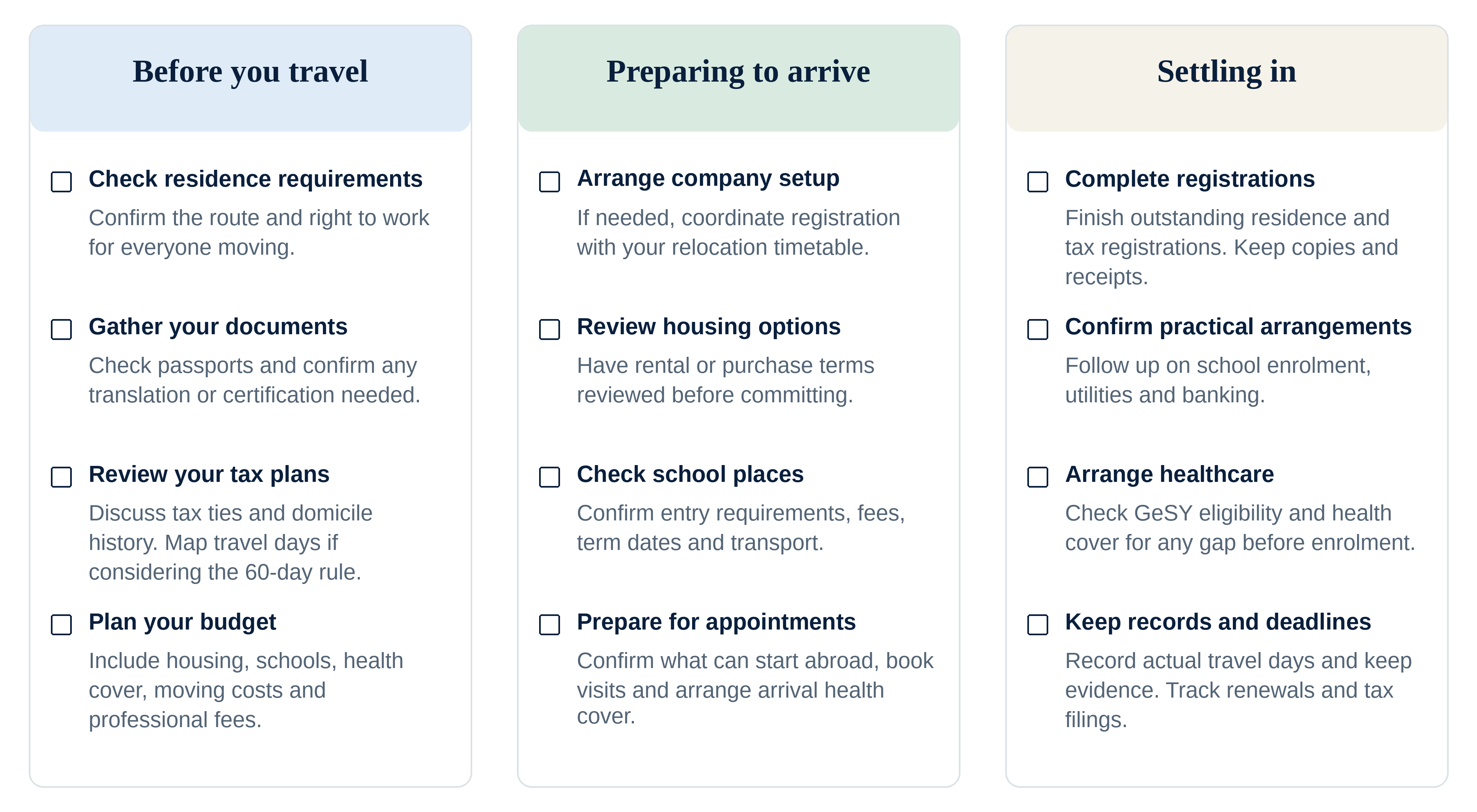
Use this checklist in this comprehensive guide to see what you can arrange before you travel and what needs your attention once you’re in Cyprus. Your immigration lawyer at the Meridian Relocation Desk will confirm which steps apply to you, manage your applications and let you know when we need a document or a decision from you.
Before you travel
Check the residence requirements for everyone moving. We explain which immigration route applies to you and what each family member needs to do.
Gather your documents. We give you a list for your application, check when your passports expire and help you arrange any translation, apostille or other certification your birth or marriage certificates need.
Plan your time in Cyprus. If you’re considering the 60-day rule, we review your travel calendar country by country and explain what evidence you’ll need for your permanent home in Cyprus and your qualifying business, employment or office here. We assess your eligibility for non-dom status separately.
Preparing to arrive
Set up your company if you need one. We handle the registration and agree when to put tax and employment arrangements in place around your move.
Check housing and school options. We help with property enquiries and can arrange a legal review of your rental or purchase agreement before you sign. If your children are moving with you, we can check which schools have places, what they need for admission and when you can visit.
Prepare for appointments. We start the applications that can go ahead from abroad, book appointments and tell you which ones you need to attend in person. We also explain what health cover your residence route requires.
Settling in
Complete your registrations. We help you finish any outstanding residence and tax registrations. Your named contact follows up on the practical matters you’ve asked us to help with, such as banking introductions, utilities, healthcare enquiries or school enrolment.
Keep track of records and deadlines. We explain how to record your travel days, which documents to keep and when renewals or tax filings are due. Our team can continue to help with residence renewals, personal tax obligations and, if you have a Cyprus company, its administration and accounts.
Download: Cyprus relocation planning checklist
Prepared by Meridian Trust's Cyprus corporate and legal team.
Frequently asked questions about moving to Cyprus
Can EU citizens move to Cyprus without a residence permit?
Yes. If you’re an EU, EEA or Swiss citizen, you can stay in Cyprus for up to three months with a valid passport or national identity card. If you plan to stay longer, you must meet the residence conditions that apply to you and apply for a registration certificate (MEU1), known as the Yellow Slip, within four months of entering Cyprus.
The documents you need depend on whether you’ll be working, studying or supporting yourself in Cyprus. Our immigration lawyers can confirm what to bring, help you prepare your application and arrange your appointment.
Can I move to Cyprus from the UK or another non-EU country?
Yes. If you’re a British or other non-EU national and can support yourself without working in Cyprus, one option is the temporary visitor residence permit, known as the Pink Slip. A single applicant generally needs to show a stable income of at least €24,000 a year from abroad. You’ll also need suitable accommodation and health cover. The visitor permit does not give you the right to take up employment in Cyprus.
British citizens can visit Cyprus without a visa for up to 90 days in any 180-day period, subject to the entry requirements. If you’re using the visitor route for a stay of more than 90 days, apply for your temporary residence permit before your permitted stay expires.
We can review your income and supporting documents and handle your application. If you intend to work for your own Cyprus company, tell us at the outset so we can assess which residence and work arrangements for non-EU citizens fit your role.
Can my spouse and children move to Cyprus with me?
Yes, if they meet the conditions for the residence route your family will use. The first things we check are each person’s nationality and which residency permit or registration they’ll need.
For a non-EU family applying under the Pink Slip visitor route, the annual income requirement starts at €24,000 for the main applicant. Add €4,800 for a spouse and €3,600 for each dependent minor child. A couple moving with two children under 18 would therefore need to show at least €36,000 a year. We can help you document that income and arrange the residency applications and appointments for each family member.
Can I work remotely for an overseas employer from Cyprus?
Yes, if your residence arrangements allow it. For eligible nationals from outside the EU and EEA, the Cyprus Digital Nomad Visa allows you to live in Cyprus while working remotely for an employer based abroad. It also covers self-employed people whose clients are outside Cyprus. You need a stable net income of at least €3,500 a month, with a higher threshold if your family joins you.
Our immigration lawyers can assess your eligibility and handle the applications for you and your family. Our tax and accounting teams can also advise on Cyprus tax, payroll and social insurance and speak directly with your employer where needed.
Official Cyprus Digital Nomad scheme
What documents should I prepare before moving?
Start with a valid passport for each person moving, or a national identity card if your route accepts one. Gather any relevant marriage and birth certificates (civil registry documents) and any existing permanent residence card, along with evidence of your income. If you’ve already arranged a home or private health insurance in Cyprus, keep your lease or purchase agreement and insurance documents to hand.
Before you pay for translations or certification, the Meridian Relocation Desk can confirm exactly what your application requires, including whether any document needs an apostille.
Can I organise my move to Cyprus before I arrive?
Yes. Before you travel, we can prepare your residence application, register your Cyprus company if you need one and assess your eligibility for Cyprus tax residency and, separately, non-dom status.
You can also shortlist homes and check school availability from abroad. We’ll tell you which appointments you need to attend in person so you can plan your visit around them.
Can I qualify for Cyprus non-dom status if I spend only 60 days a year in Cyprus?
Yes, if you qualify for Cyprus tax residency under the 60-day rule and separately meet the non-dom conditions. For tax residency, you must spend at least 60 days in Cyprus during the calendar year and no more than 183 days in any one other country. You must also maintain a permanent home in Cyprus, which you can own or rent.
You must also run a business in Cyprus, work here as an employee or hold an office, such as a directorship, with a Cyprus tax-resident company. That business activity, employment or office must continue through the end of the year. We review your domicile history separately to establish whether you qualify for non-dom status.
From 2026, being tax resident elsewhere does not, by itself, rule you out. The day limits still apply. For example, spending 60 days in Cyprus and the rest of the year in the UK would take you over the UK day limit for the Cyprus test. If both countries treat you as tax resident, we can review the applicable tax treaty with your adviser abroad.
What does Cyprus non-dom status mean for my income?
If you’re tax resident in Cyprus and qualify for non-dom status, you can receive dividends from your own Cyprus company or from companies abroad free of Cyprus income tax and Special Defence Contribution. GeSY healthcare contributions may still apply to those dividends. Your salary is taxed under the rules for employment income.
Do I need to buy a property to move to Cyprus?
No. You can rent a home in Cyprus. If you’re applying for a visitor residence permit, a suitable long-term rental agreement can serve as evidence of accommodation. A rented home can also meet the permanent-home requirement under the 60-day tax residency rule.
How do I arrange healthcare when I move to Cyprus?
Healthcare in Cyprus offers advanced medical services accessible through public and private hospitals and clinics. Access through GeSY depends on eligibility and registration. Most doctors can communicate in English.
Before you travel, check what health cover your residence application requires and whether each family member will be eligible for GeSY, Cyprus’s public healthcare system. If you qualify, enrol in the GeSY Beneficiary Registry and register with a participating personal doctor. Arrange cover for any gap between your arrival and the start of your GeSY coverage.
How long does it take to arrange my move to Cyprus?
The timing depends mainly on which residence route you’ll use, how quickly you can gather the documents and when appointments are available. Your earliest practical moving date may also depend on when your home is ready, when your company needs to be registered or when your children can start school.
For short-stay entry visas, processing usually takes around 15 days, but may extend to 45 days if further checks or additional documents are needed.
Once we know your intended arrival date and any tax residency plans, we can set out a timetable showing what can start now and when you’ll need to be in Cyprus.
Discuss your plans for Cyprus
If you’re planning a move and seeking professional advice, tell us who’s coming with you, whether you have questions about a work visa or student visa, and when you’d like to arrive. If you’re considering the 60-day rule, let us know how you expect to divide the year between countries, including your home country, where you plan to stay in Cyprus and whether you’ll work, run a business or hold a directorship here.
Speak to the Meridian Relocation Desk
Tell us when you’d like to move to Cyprus, who will be moving with you and what you’d most like to get settled before you arrive. Perhaps you need to know whether you can work through your own Cyprus company, whether your travel plans fit the 60-day rule, or whether your children can start school in time for the new term.
Your immigration lawyer will talk through those priorities with you, involve the colleagues you need and explain what you can start arranging from abroad.
Main photo by Savvas Argyrou on Unsplash | Photo by The Anam on Unsplash