Why Should You Establish a Holding Company in Cyprus?
A Cyprus limited liability company provides a practical structure for owning shares and investments in other businesses, receiving dividends and managing investment income. Importantly, it can also allow profits received at holding-company level to be retained and reinvested into new businesses, acquisitions or other investments without the additional tax leakage that can arise when profits are first distributed to the individual shareholder, subject to the applicable Cyprus tax rules.
Cyprus is particularly attractive as a holding company jurisdiction because it combines a highly favourable holding-company tax regime with the security and credibility of an EU jurisdiction. Qualifying dividend income and gains from the disposal of shares is normally tax exempt, while Cyprus generally imposes no withholding tax on outbound dividends. This can make it possible to receive, retain and redeploy investment profits efficiently within the corporate structure.
Beyond tax efficiency, Cyprus offers a stable and well-established legal and regulatory environment. As an EU Member State with a legal system strongly influenced by English common law, it provides investors with legal certainty, strong shareholder protections and a familiar corporate framework, together with access to Cyprus's extensive network of double tax treaties.
At Meridian Trust, we support clients throughout the entire lifecycle of their holding structure — from Cyprus company formation and initial structuring to ongoing corporate administration, accounting, tax and compliance. Our team works with you from the outset to establish an arrangement tailored to how you intend to hold, manage and grow your investments, and continues to support you as your business and investment needs evolve. Book a free consultation to discuss the most appropriate structure for your objectives.
Who Should Use a Cyprus Holding Company?
A holding vehicle can be useful where a business or investor owns interests in other companies, investments or assets across more than one jurisdiction. It provides a central company through which those interests can be owned and managed and can make future acquisitions, investments and disposals easier to structure.
The suitability of a Cyprus Company will depend on what is being held, where the underlying companies or assets are located and what the owners intend to do with them. An important consideration is therefore whether the structure makes commercial sense for the particular business or investment, rather than simply whether Cyprus offers an attractive tax regime.
Businesses with Operating Subsidiaries
A business with one or more subsidiaries may use a holding entity as the parent company of the group. Instead of the shareholders owning each operating company directly, the subsidiaries are held through the Cyprus parent.
This creates a clearer group structure and can make it easier to add new subsidiaries, enter new markets, bring in investors or sell a particular part of the business. It can be particularly useful for international businesses whose operations are spread across several countries.
Technology and Software Businesses
For technology businesses, a Cyprus holding structure can separate ownership of valuable assets from day-to-day trading operations. Depending on the structure, intellectual property such as software, patents and trademarks may be held separately from the operating company.
Cyprus can also be attractive to businesses developing qualifying intellectual property because of its IP Box Regime. Where the relevant requirements are met, qualifying IP income may benefit from an effective tax rate significantly below the standard Cyprus corporate tax rate.
A holding structure can also be useful when a technology company is raising capital or preparing for an eventual sale. Investors acquire an interest at parent-company level, while different operating businesses or assets can remain in separate subsidiaries. If a subsidiary is later sold, gains from the disposal of qualifying shares are generally exempt from Cyprus tax, subject to the applicable rules.
Investors and Investment Groups
Investors building a portfolio of businesses can use a Cyprus parent entity to hold those investments through a single entity. Dividends and disposal proceeds can be received centrally and, where the relevant exemptions apply, used for further investment without additional Cyprus tax at holding-company level.
This can work particularly well for private investors, investment groups, private equity and venture capital investors that expect to make a series of acquisitions and disposals rather than hold a single investment indefinitely.
Family Offices and Private Wealth
Families with business interests and investments in different countries may use an investment holding vehicle to bring those interests under a common ownership structure.
Rather than holding shares in numerous companies personally, family members can hold their interests through a Cyprus-based entity. This can make ownership and governance easier to manage and can also assist with succession planning and the transfer of wealth to the next generation.
The holding company does not replace a Cyprus International Trust, foundation or other succession-planning arrangement where one is required, but it can form an important part of the wider family ownership structure.
International Property Investors
An Investment holding company may be used to own shares in companies that themselves own property outside Cyprus. This is particularly relevant where an investor has properties or property-owning companies in several jurisdictions.
Using a holding company can make the portfolio easier to manage and may provide greater flexibility when bringing in co-investors, financing an acquisition or disposing of a particular property-owning company.
The tax treatment of property structures is highly dependent on the country in which the property is situated, so the local tax rules and the relevant Double Tax Treaty should always be considered before establishing the structure.
Businesses Planning Acquisitions or a Future Exit
It is often better to establish the right holding structure before undertaking mergers and acquisitions (M&A), raising investment or preparing for a future sale, rather than trying to reorganise the business immediately before the transaction.
A strategic holding structure can provide a platform through which new businesses are acquired and future subsidiaries are added. Profits and disposal proceeds received by the holding company may then be available for further acquisitions or investment, subject to the applicable tax rules.
The structure can also provide greater flexibility on exit. A shareholder may sell the entire group, the holding company may sell an individual subsidiary, or a new investor may acquire an interest in the parent company. Where the relevant Cyprus exemptions apply, gains from the disposal of qualifying shares are generally exempt from Cyprus tax.

Benefits and Advantages of a Holding Company in Cyprus
Setting up a parent company in Cyprus offers several major benefits, including quick and easy setup, favorable tax regime (0% withholding tax and 0% corporate tax on dividends received, subject to very easy to meet requirements), streamlined cross-border transactions, and more.
At Meridian Trust, we have all the skills in-house to help you establish a corporate vehicle in Cyprus.
How Does the Taxation Work, and What Are the Tax Advantages for a Cyprus Holding Company?
The Cyprus tax system offers an attractive tax regime for international holding structures, making Cyprus one of the most competitive jurisdictions in Europe for holding and managing investments.
- 0% Cyprus corporate tax on qualifying dividend income received from foreign subsidiaries.
- 0% Cyprus capital gains tax on the disposal of shares in subsidiaries (unless they hold real estate situated in Cyprus), making Cyprus an ideal jurisdiction for holding and exiting investments.
- 0% withholding tax on dividends paid by a Cyprus entity to a non–Cyprus resident shareholder.
- No inheritance taxes or succession taxes, which makes the entity an excellent option for preserving wealth over the long term and passing it on to the next generation.
- Access to the benefits of the EU Parent – Subsidiary Directive, enabling tax-efficient intra-group distributions within the European Union where applicable.
- Access to Cyprus’ extensive network of over 65 double taxation treaties, which can significantly reduce foreign withholding taxes on dividends and other cross-border payments.
- A centralised holding platform for acquiring, owning and managing international subsidiaries, facilitating future expansion and investment acquisitions.
If you’re interested in establishing a holding company in Cyprus, we can help you choose and create the ideal corporate structure to take full advantage of the tax benefits most relevant to you.
Typical Holding Company Structures
A holding company in Cyprus can be structured depending on your commercial objectives and your long-term tax and investment strategy. Whether your goal is to manage international operations, hold intellectual property, own investment assets or prepare for a future business sale, a Cyprus parent entity provides a flexible and efficient ownership structure.
Below are some common examples of how international businesses and investors structure their holdings through Cyprus.
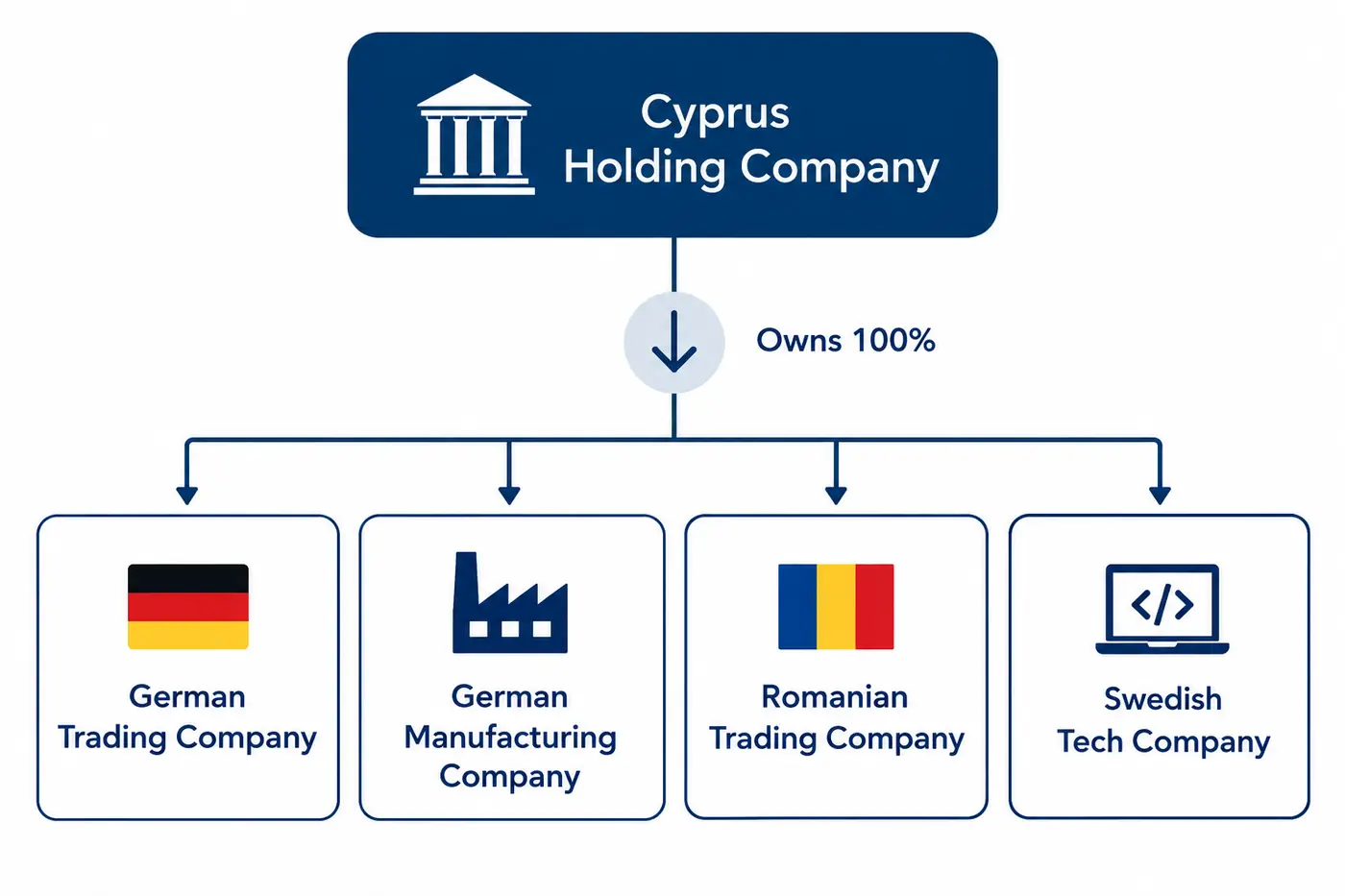
International Corporate Group
A parent company can sit at the top of an international group and own one or more operating subsidiaries in different countries. Each subsidiary continues to run its own business, while ownership of the group is brought together under the Cyprus parent.
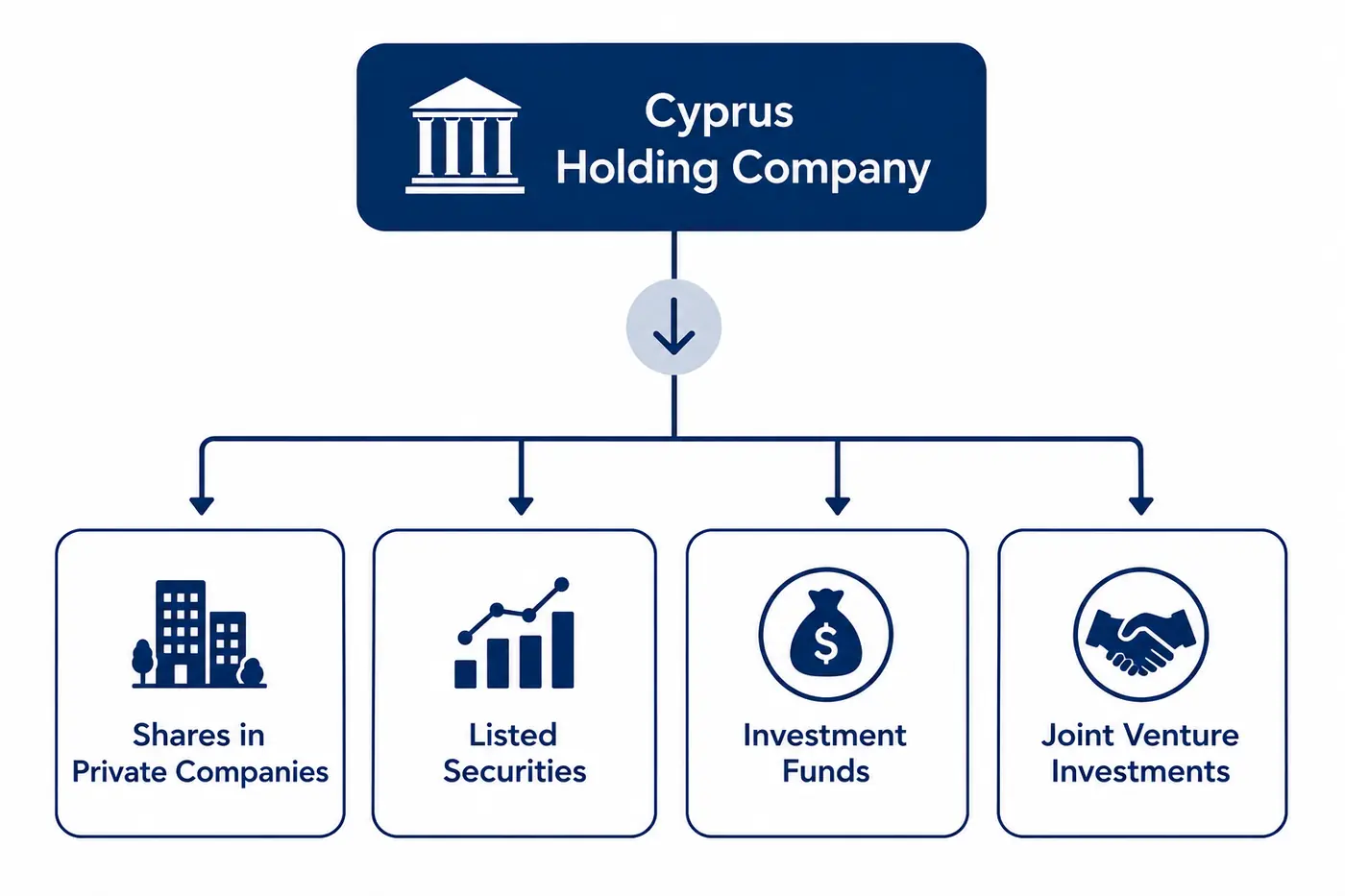
Investment Holding Structure
Investors can use a Cyprus investment vehicle to own interests in several businesses or investments through one company rather than holding each investment directly.
Dividends and proceeds from investments can be received by the holding company and, subject to the applicable Cyprus tax rules, retained or reinvested into new opportunities.
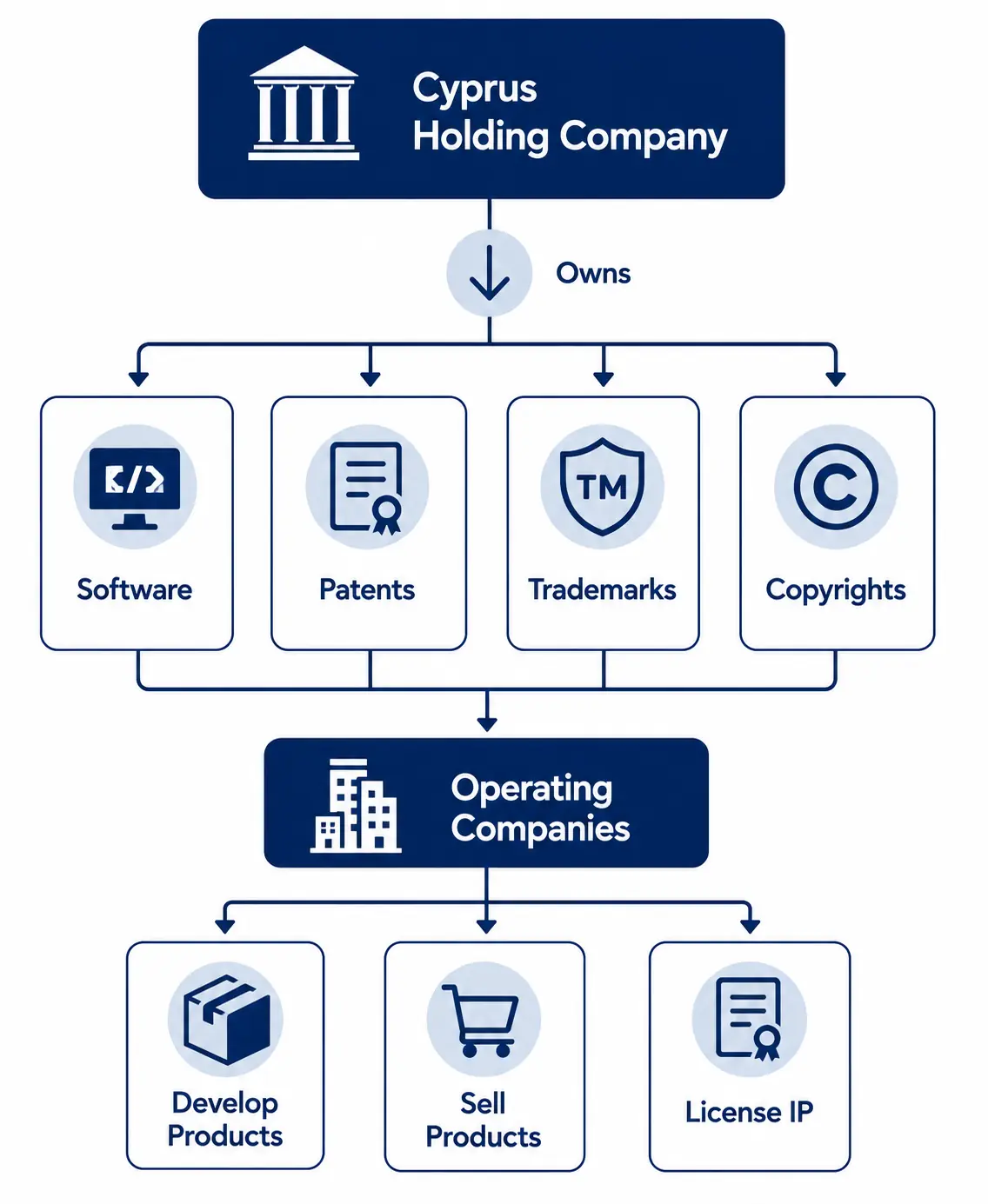
Intellectual Property Holding Structure
For some technology and innovation-driven businesses, it makes commercial sense to separate valuable intellectual property from the company carrying on the day-to-day business. A dedicated IP company can make it easier to manage intellectual property efficiently and implement appropriate measures for protecting intellectual property.
A Cyprus company may hold intellectual property such as software, patents or trademarks and license its use to operating companies within the group.
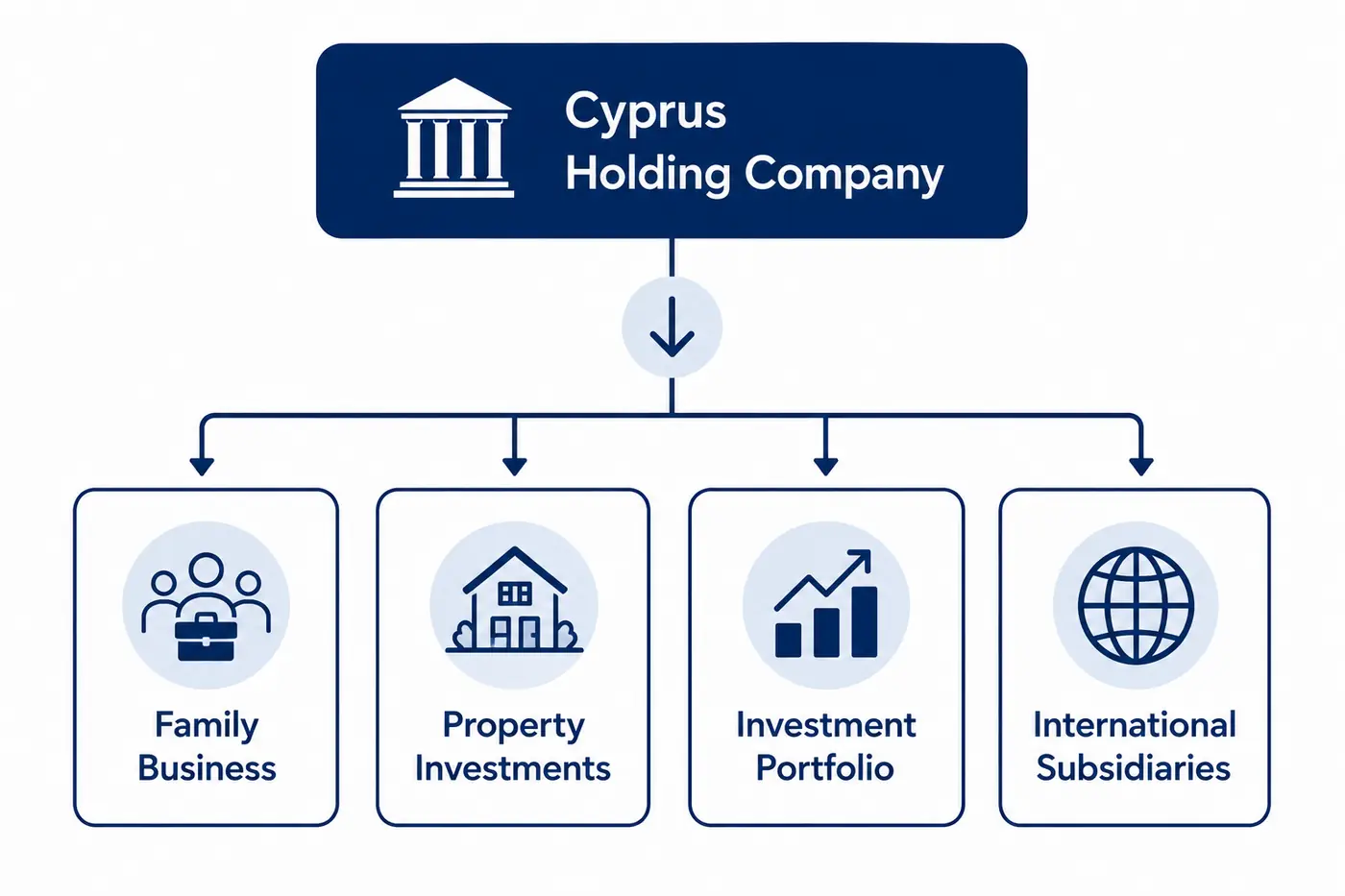
Family Investment Structure
A Cyprus ownership structure can bring family-owned businesses and investments under one structure rather than having individual family members hold interests in each asset separately.
This can make ownership easier to manage, establish clearer rules for control and decision-making and assist with longer-term succession planning.
Startup & Technology Founder Holding Structure
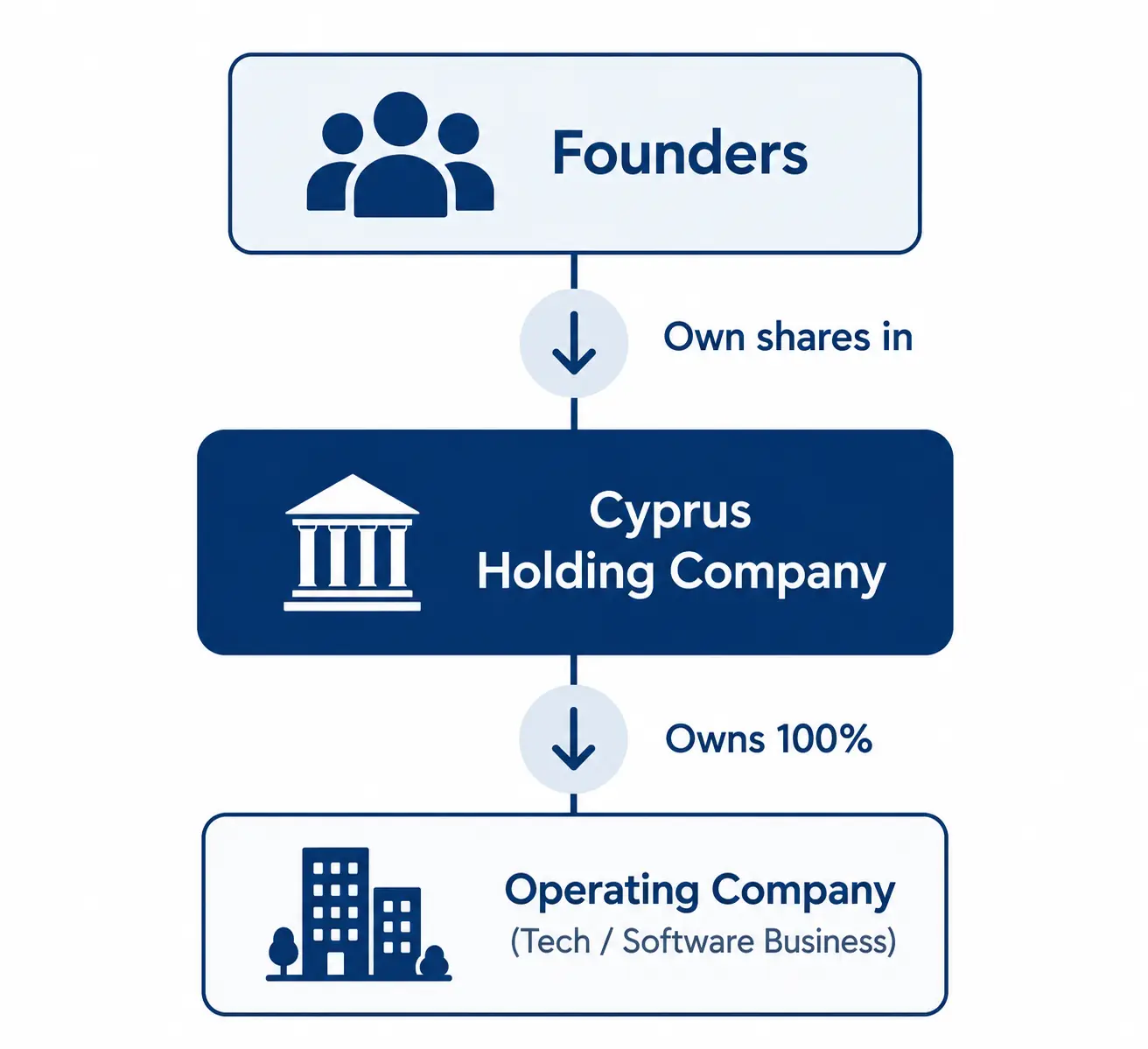
Founders of startups and technology companies may choose to hold their shares in the operating business through a Cyprus holding company rather than owning them personally.
This can be particularly useful where the founders expect to raise investment, expand internationally or eventually sell the business. The holding company gives the founder a corporate vehicle through which to hold the investment and can make it easier to reinvest proceeds into a new business or other investments after an exit.
It can also have important tax advantages. Dividends received by a Cyprus entity are generally exempt from Cyprus corporate income tax, subject to the applicable conditions, while gains from the disposal of qualifying shares are generally exempt from Cyprus tax. This can be particularly valuable where a founder sells an operating company but intends to keep the proceeds within the holding company and reinvest them rather than immediately extracting the money personally.
The structure can also provide greater flexibility when investors come in. Investment can be made at the appropriate level of the group, while different businesses, intellectual property or future ventures can be kept in separate subsidiaries where commercially appropriate.
Is Cyprus the Best Holding Company Jurisdiction?
The best location for a holding company depends on your commercial objectives, the shareholders' tax residency and your long-term investment and exit strategy.
For many international businesses and investors, Cyprus remains an attractive choice. It combines an EU legal and regulatory framework, with an English common law-based legal system, broad exemptions for dividend and gains from the sale of shares, no withholding tax on dividends paid abroad and an extensive network of Double Tax Treaties.
This combination makes Cyprus particularly relevant for entrepreneurs and investors building international businesses, holding subsidiaries in several countries, reinvesting profits or planning for a future exit.
Why Many Businesses Choose Cyprus
Feature | Cyprus | Why It Matters |
EU Member State | ✔ | Access to the EU Single Market and a well-regulated business environment. |
Corporate Tax on Dividends | Generally none | 0% corporate tax on dividends subject to very easy to meet requirements. |
Participation Exemption | ✔ | Dividend income and gains from the disposal of shares may be exempt from Cyprus taxation, subject to the applicable conditions. |
Withholding Tax on Outbound Dividends | Generally none | Cyprus generally does not impose withholding tax on dividends paid to non-resident shareholders. |
Double Tax Treaties | 65+ | Reduces the risk of double taxation and may lower withholding taxes on cross-border payments. |
English Common Law System | ✔ | Familiar legal framework trusted by international investors and businesses. |
EU Directives | ✔ | Access to key EU tax directives, where applicable. |
Intellectual Property Regime | ✔ | The Cyprus IP Box Regime offers significant tax benefits for qualifying intellectual property income. |
Best Holding Company Jurisdictions Compared: Cyprus, Luxembourg, Netherlands, Malta, Ireland, UAE & Singapore (2026)
Cyprus is frequently compared with jurisdictions such as Luxembourg, the Netherlands, Malta, the United Arab Emirates and Singapore. While each offers distinct advantages, Cyprus is often preferred because it combines an attractive tax framework with relatively straightforward administration, reasonable operating costs and a well-established legal and professional services sector.
| Cyprus | Luxembourg | Netherlands | Malta | Ireland | UAE | Singapore |
Corporate tax rate | 15% from 2026 | 16% CIT; ~23.87% combined in Luxembourg City | 19% up to €200k; 25.8% above | 35% headline; shareholder refund/imputation system can materially reduce final burden | 12.5% trading; 25% non-trading | 0% up to AED 375k; 9% above; qualifying Free Zone income can be 0% | 17% |
Qualifying dividends received | Generally, exempt | Exempt | Exempt under participation exemption | Participation exemption may apply | Exempt under foreign-distribution participation exemption | Exempt under participation exemption | Domestic dividends generally exempt; qualifying foreign dividends may be exempt |
Qualifying share-sale gains | Generally, exempt | Exempt | Exempt under participation exemption | Participation exemption may apply | Exempt under s.626B | Exempt under participation exemption | Capital gains generally not taxed; qualifying equity disposals can also benefit from statutory exemption |
Outbound dividend WHT | Generally, 0% | 15% standard; 0% can apply | 15% standard; exemption can apply | Generally, 0% to non-residents | 25% standard; exemptions can apply | 0% | 0% |
Core participation test | No classic minimum shareholding test for the general securities-gain exemption | Generally, 10% / €1.2m for dividends; 10% / €6m for gains; 12-month holding | Generally, 5% | Multiple statutory “participating holding” tests | Generally, 5% for 12 months, plus relevant conditions | Generally, 5% / 12 months, subject to tax and other tests* | No single classic participation test; different rules apply to foreign dividends and equity disposals |
EU / Parent-Subsidiary Directive | Yes | Yes | Yes | Yes | Yes | No | No |
Treaty network | 69 agreements listed by MoF | Extensive global network | Extensive global network | Broad treaty network | 75 in force; 78 signed | 140+ bilateral DTAs | Broad Asia/global network |
Typically, best suited for† | International founders, investment groups, cross-border holdings and reinvestment/exit structures | Large multinational groups, institutional investors and complex investment/M&A structures | European headquarters and multinational groups with substantial operations | EU holding/trading structures where Malta's participation or tax-refund system fits the ownership structure | EU/US-linked operating groups, technology companies and substantive multinational headquarters | Middle East/GCC headquarters, regional holdings and groups preferring a non-EU base | Asia-Pacific headquarters, regional investment structures and Asian operating groups |
Would you like to keep this comparison for future reference?
Download the high-resolution Cyprus Holding Company Jurisdictions Comparison (PNG)
Key findings: Cyprus stands out for the combination of generally exempt qualifying dividend income, generally exempt gains on securities and generally 0% outbound dividend withholding tax. Luxembourg and the Netherlands offer established participation-exemption regimes but impose minimum participation requirements. Ireland combines a competitive operating-company regime with participation exemptions but has a 25% standard dividend withholding tax, subject to exemptions. UAE and Singapore provide 0% outbound dividend withholding tax but do not have access to the EU Parent-Subsidiary Directive.
Sources: Comparison researched and verified on 6 September 2026 using official government and tax authority sources, including the Cyprus Tax Reform portal, Luxembourg Inland Revenue, Netherlands Government, Malta Tax & Customs Administration, Irish Revenue, UAE Ministry of Finance, Singapore IRAS and the European Commission. Tax exemptions are subject to the conditions indicated and applicable legislation.
- https://www.gov.cy/taxreform/
- https://impotsdirects.public.lu/fr/az/c/charg_fisc.html
- https://www.government.nl/themes/taxes-benefits-and-allowances/taxation-and-businesses/corporation-tax
- https://mtca.gov.mt/business-tax/corporate/corporate_tax
- https://www.revenue.ie/en/companies-and-charities/corporation-tax-for-companies/corporation-tax/basis-of-charge.aspx
- https://mof.gov.ae/en/public-finance/tax/corporate-tax-in-the-uae/
- https://www.iras.gov.sg/quick-links/tax-rates/corporate-income-tax-rates
- https://taxation-customs.ec.europa.eu/taxation/business-taxation/parent-subsidiary-directive_en
Methodology: Meridian compared seven commonly used international holding-company jurisdictions across eight factors relevant to holding structures: corporate taxation, taxation of dividends received, taxation of share disposals, outbound dividend withholding tax, participation requirements, access to the EU Parent-Subsidiary Directive, treaty network and typical use cases. The comparison reflects legislation and official guidance available as at 6 September 2026.
Important: This table provides a high-level comparison for general information purposes only and does not constitute tax, legal or investment advice.
Why International Investors Continue to Choose Cyprus
Tax is only part of the reason Cyprus works well as a holding company jurisdiction. Cyprus is an established international financial centre with a well-developed network of lawyers, accountants, auditors and corporate service providers experienced in cross-border structures. Its EU Membership, together with a legal system based on English common law, provides international investors with a familiar and credible environment in which to structure and manage cross-border investments.
Just as importantly, Cyprus operates within the EU legal and regulatory framework and is subject to international standards on tax transparency and compliance. For businesses looking for a holding structure they can use over the long term — to own subsidiaries, receive investment, work with banks and professional advisers, and eventually sell or restructure their interests — this combination of tax efficiency, legal certainty and a recognised EU framework can be particularly valuable.
Tax Example: How a Cyprus Holding Company Can Receive Dividends
The following simplified example illustrates how a Cyprus Ltd may be used to receive dividend income from an overseas subsidiary.
Example: Parent Cyprus Company Receiving Dividends
Step | What Happens |
1. Operating Company | A German subsidiary generates profits arising from its trading activities. |
2. Dividend Payment | The German company declares and pays a dividend of €1 million to its Cyprus parent company. |
3. Receipt in Cyprus | Subject to very easy to meet requirements, the dividend received by the Cyprus Co is exempt from Cyprus corporation tax. |
4. Distribution to Shareholders | Cyprus generally does not impose withholding tax on dividends paid to non-resident shareholders. |
5. Result | The €1 million is now available at the Cyprus entity level. Rather than distributing it immediately to the ultimate shareholders, the group can use the funds to acquire another business, finance an existing subsidiary or make new investments. This keeps the profits within the corporate structure and allows them to be reinvested without first being paid to the shareholders personally and potentially triggering tax in their country of residence. The shareholders can then decide when and how to take funds out of the holding company, taking into account their personal tax position at that time. |
Example: Sale of a Subsidiary (Exit Planning)
Step | Example |
1. Ownership | A CyCo owns 100% of a software subsidiary company operating within the EU |
2. Business Growth | Over several years, the subsidiary software business increases significantly in value. |
3. Exit | An international buyer acquires the shares of the subsidiary company for €15 million. |
4. Tax Treatment | Subject to the applicable conditions, gains realised by the CyCo on the disposal of the shares are exempt from capital gains tax. |
5. Result | The €15 million sale proceeds are received by the Cyprus based entity. Where the relevant exemption applies, the gain is not subject to tax in Cyprus, leaving the full proceeds available within the holding structure. The founders can use those funds to invest in a new business, acquire other companies or make further investments without first distributing the money to themselves personally and potentially triggering personal tax on the distribution. This allows the sale proceeds to remain invested and working for the founders until they decide whether, when and how to extract funds personally. |
Cyprus Holding Company Substance Requirements
Incorporating a Cyprus holding company is straightforward. Making sure it is properly managed and supported in Cyprus is just as important.
Where a company is relying on Cyprus tax residence, Double Tax Treaties or EU tax benefits, it should be able to demonstrate that Cyprus is genuinely the place from which the company is managed. In practice, this may involve having local directors, board meetings and key decisions taking place in Cyprus, proper accounting and corporate records or a Cyprus bank account.
How much substance is needed will depend on what the holding company actually does. A company that simply holds shares in one subsidiary will not necessarily require the same level of presence as a holding company that actively manages a large international group, provides financing or carries out other functions.
At Meridian Trust, we look at the structure as a whole and advise on the level of substance that is appropriate for the company and its activities. This includes management and control, directors, governance, administration and ongoing compliance, so that the company is not simply incorporated here, but is properly established and managed from Cyprus.
Understanding Substance Requirements in Cyprus
Cyprus Tax Residency | Helps establish Cyprus as the place of management and control where appropriate. |
Cyprus Resident Directors | Demonstrates that strategic decisions are made in Cyprus. |
Board Meetings | Important corporate decisions should be properly documented and, where appropriate, held in Cyprus. |
Corporate Records | Companies should maintain accurate accounting records, statutory registers and corporate documentation. |
Commercial Purpose | The holding company should have a genuine commercial rationale beyond tax considerations. |
Ongoing Compliance | Annual accounting, audit, tax filings and corporate compliance obligations must be met. |
Common Mistakes When Establishing a Cyprus Holding Company
A Cyprus holding structure can offer significant legal, commercial and tax advantages when structured correctly. However, a poorly planned structure may result in unnecessary tax exposure, increased compliance obligations or reduced flexibility for future growth and investment.
Careful planning from the outset is essential to ensure that the holding company is aligned with your commercial objectives and complies with both Cyprus and international tax rules.
Some of the most common mistakes include:
Choosing a Jurisdiction Based on Tax Alone
A low tax rate is not enough to make a jurisdiction suitable for a holding company. The tax residence of the shareholders, the countries in which the subsidiaries operate, applicable Double Tax Treaties, withholding taxes and the longer-term plans for the business can all affect whether a structure actually works.
The right question is not simply, “Where is the tax lowest?” but “Which jurisdiction works best for this particular business and its owners?”
Failing to Establish Proper Substance
Incorporating a company in Cyprus does not, by itself, mean that the company will be treated as genuinely managed from Cyprus for every tax or treaty purpose.
Management and control, the role of the directors, where important decisions are made and the company's actual activities all need to be considered. The appropriate level of substance will depend on what the holding company does and the countries involved.
Getting the Ownership Structure Wrong
Who owns the holding company can be just as important as what the holding company owns.
A structure that works today may become unnecessarily complicated when a new investor comes in, another founder joins, a subsidiary is sold or the owners want to take money out of the business. This is particularly important for startups and founder-led businesses, where the ownership structure may change considerably as the company grows.
Mixing Holding and Operating Activities Without a Reason
There may be circumstances where a CyCo both holds investments and carries on business, but the two should not be combined simply for convenience.
Keeping valuable shares, intellectual property or other assets separate from day-to-day trading activities can make the group easier to manage and may help isolate those assets from the commercial risks of the operating business.
Ignoring International Tax Rules
When setting up an international structure, effective international tax planning requires consideration of the tax rules that apply not only in Cyprus but also in the countries where the shareholders and subsidiaries are located. Issues such as Controlled Foreign Company (CFC) rules, withholding taxes, transfer pricing and applicable Double Tax Treaties should all be reviewed before implementing the structure.
Waiting Until an Exit or Investment Is Already on the Table
This is one of the most important mistakes to avoid.
If you expect to raise investment, acquire other businesses or eventually sell your company, it is worth thinking about the holding structure early. Trying to insert a holding company shortly before an investment round or sale can be more complicated and may itself have tax consequences.
For founders in particular, establishing the right ownership structure while the business is still relatively young can provide considerably more flexibility later — whether that means bringing in investors, creating new subsidiaries, making acquisitions or selling the business.
At Meridian Trust, we prefer to start with what the client is actually trying to achieve and work backwards from there. A holding structure should make the ownership and future development of the business simpler, not create another layer of complexity.
Failing to Obtain Professional Advice
Every international business is different, and there is no universal holding company structure that suits every situation. Professional legal and tax advice is essential to ensure that the proposed structure is commercially appropriate, tax-efficient and fully compliant with the applicable laws and international standards.
Key Advantages of Choosing Cyprus
Advantage | Benefit to International Investors |
European Union Member State | Operate from a respected EU jurisdiction with access to the European Single Market and EU legislation. |
Competitive Corporate Tax Rate | One of the lowest corporate tax rates in the European Union at 15%, whereas dividends received in a Cyprus Ltd are subject to 0% corporate tax, subject to very easy to meet requirements. |
Participation Exemption Regime | Dividend income and gains from the disposal of shares may be exempt from Cyprus taxation, subject to the applicable conditions. |
No Withholding Tax on Outbound Dividends | Cyprus generally does not impose withholding tax on dividends paid to non-resident shareholders. |
Extensive Double Tax Treaty Network | More than 65 Double Tax Treaties help reduce double taxation and facilitate cross-border investment. |
English Common Law Legal System | Cyprus company law is based on familiar common law principles, providing an internationally recognised legal framework and greater certainty for businesses and investors. |
Cyprus IP Box Regime | Significant tax benefits may be available for qualifying intellectual property income. |
Strategic Location | An ideal gateway connecting Europe, the Middle East, Asia and Africa. |
Highly Skilled Professional Services | Access to experienced lawyers, accountants, auditors and corporate service providers with international expertise. |
Efficient Company Administration | Straightforward incorporation procedures and a well-developed corporate services infrastructure. |
How we structure Cyprus Holding Companies
We do not start by incorporating the company. We start by understanding what the holding company needs to do.
Who will own it? What companies or assets will sit underneath it? Where are the shareholders and subsidiaries tax resident? Will profits be distributed or reinvested? Are you planning further acquisitions, outside investment or an eventual sale?
The answers determine how the structure should be set up. Our legal, tax and accounting teams look at the structure together before implementation, so that the Cyprus company works not only when it is established, but as the business grows.
How We Help
Step | How We Help |
1. Initial Consultation | We begin by understanding your business, international operations, investment objectives and long-term plans. |
2. Review the Tax Position | We consider the Cyprus tax treatment alongside the position in the countries where the shareholders, subsidiaries and investments are located. This includes dividend flows, withholding taxes, applicable Double Tax Treaties and the tax consequences of a future disposal or distribution. |
3. Design the Structure | We map out how the holding company should be owned, what it should hold and how funds will move through the group. Where appropriate, we also consider whether operating businesses, intellectual property or other valuable assets should be held separately. |
Once the structure is agreed, we incorporate the company, prepare the corporate and legal documentation and complete the necessary registrations. | |
We assist with opening corporate bank accounts, obtaining tax registrations and any other regulatory registrations required for your business. | |
6. Accounting and Corporate Administration | We provide ongoing accounting, audit coordination, company secretarial services, corporate administration and tax compliance, ensuring your holding company remains fully compliant with Cyprus legislation. |
7. Stay With You as the Structure Develops | A holding structure rarely stays exactly the same. New subsidiaries are added, businesses are acquired or sold, investors come in and shareholders' plans change. We continue to advise and adjust the structure when needed, rather than treating incorporation as the end of the process. |
Frequently Asked Questions
What is a Cyprus holding company?
A Cyprus holding company is a Cyprus-registered company used primarily to own shares in other companies or hold investments and assets.
It may act as the parent company of one or more subsidiaries in Cyprus or abroad. Holding companies are commonly used to receive dividends, hold investments, organise ownership of an international group, reinvest profits and plan for future acquisitions or exits.
A holding company does not necessarily have to be completely non-trading. Its activities will depend on the purpose and design of the structure.
Who can set one up?
A Cyprus Ltd can be established by Cyprus or non-Cyprus residents. There is no requirement for the shareholder to live in Cyprus.
A private Cyprus company must have at least one shareholder, one director, a company secretary and a registered office in Cyprus.
Holding structures are not limited to large corporate groups. They can also be used by founders, family-owned businesses and individual investors holding interests in companies or investments internationally.
What are the main tax benefits of a Cyprus holding company
Cyprus - based holding entities can benefit from a particularly favourable tax regime for holding and disposing of investments. The main advantages include exemptions that may apply to dividend income and gains from the disposal of shares, generally no withholding tax on dividends paid to non-resident shareholders, and access to Cyprus's extensive network of Double Tax Treaties.
Dividends received: Dividend income received by a Cyprus company is generally exempt from Cyprus corporate income tax, subject to limited exceptions.
Sale of shares: Gains from the disposal of qualifying shares and other securities are generally exempt from Cyprus tax, with exceptions including certain cases involving Cyprus immovable property.
Outbound dividends: Cyprus generally does not impose withholding tax on dividends paid to non-resident shareholders, subject to specific anti-avoidance rules and exceptions.
Double Tax Treaties: Cyprus has an extensive network of Double Tax Treaties that may reduce foreign withholding taxes and prevent the same income from being taxed twice.
EU framework: Cyprus companies may benefit from EU directives, including the Parent-Subsidiary Directive, where the relevant conditions are satisfied.
These rules can be particularly valuable where profits or sale proceeds are retained within the holding company and reinvested. Instead of immediately distributing the funds to the individual shareholders and potentially triggering personal taxation in their country of residence, the holding company may use them for new investments, acquisitions or group financing.
Can a Cyprus holding company own foreign subsidiaries?
Yes. It can own shares in companies located in other countries.
For example, a Cyprus parent company could own operating subsidiaries in Germany, France, Romania and Sweden. This allows the ownership of an international group to be centralised through one parent company while each subsidiary continues to operate in its own jurisdiction.
Can a Cyprus holding company be used by startup founders?
Yes. Startup and technology founders can hold their shares in an operating company through a Cyprus corporate vehicle rather than owning them personally.
This can provide greater flexibility when new investors come in, additional subsidiaries are created or the business is eventually sold. If qualifying shares are sold by the Cyprus entity, the gain is generally exempt from Cyprus tax, subject to the applicable rules and exceptions.
The sale proceeds can then remain within the holding company and be reinvested in another business or investment without first being distributed to the founder personally and potentially triggering personal taxation.
Can a Cyprus holding company hold intellectual property?
Yes, although the appropriate structure depends on the nature and use of the intellectual property.
A Cyprus company can own intellectual property such as software, patents and trademarks and may license that IP to other companies. Qualifying IP income may benefit from the Cyprus IP Box Regime where the relevant requirements are satisfied.
Can a Cyprus holding company own real estate?
Yes. It can own shares in companies that hold real estate in Cyprus or abroad and may also own property directly.
The tax treatment of property structures depends heavily on where the property is located. Local property taxes, capital gains tax, Double Tax Treaties and the Cyprus rules applicable to companies deriving value from immovable property should therefore be considered before the structure is established.
What documents are required to establish a Company in Cyprus?
The documents required will depend on the shareholders, directors and proposed activities of the company, but typically include:
passport or identification documents for the shareholders and directors;
recent proof of residential address;
information on the source of funds and source of wealth;
details of the proposed ownership structure;
information on the company's intended activities and underlying subsidiaries or investments; and
supporting corporate documents where a shareholder is another company.
As part of the incorporation, the company's name, registered office, shareholders, directors, secretary and share capital must also be determined, and its Memorandum and Articles of Association prepared.
Additional documents may be required for compliance, tax registration, banking particularly where the ownership structure includes trusts or other legal entities. In such cases, information and supporting documentation relating to the ultimate beneficial owners, may also be required.
What are the ongoing compliance requirements?
All Cyprus entities must maintain proper accounting and corporate records and comply with annual tax, accounting and statutory filing requirements.
This generally includes maintaining statutory registers, recording changes to directors and shareholders, keeping accounting records, preparing annual financial statements, filing the required tax returns and maintaining up-to-date beneficial ownership information.
The precise requirements will depend on the company's activities and structure. Companies should also ensure that their management and substance arrangements remain appropriate, particularly where Cyprus tax residence or treaty benefits are being relied upon.
How is a Cyprus holding company managed and controlled?
A Cyprus private company must have at least one director, one shareholder, a company secretary and a registered office in Cyprus.
Where the company is intended to be tax resident and genuinely managed from Cyprus, the way it is actually governed is important. Key decisions should be taken at the appropriate level by directors with real decision-making authority, and the company's management arrangements should reflect what it actually does.
Simply registering a company in Cyprus is not, on its own, a substitute for proper management and substance. Book a free consultation to discuss the most appropriate structure for your objectives.