Your ideas, software and technology are at the heart of your business. The Cyprus IP Box regime can help you retain more of the profits your intellectual property generates, giving you more to invest in what comes next.
With an 80% tax deduction on qualifying profits, eligible businesses can reduce their effective Cyprus corporate tax rate to as low as 3%. The Cyprus IP Box can reduce tax on profits from software, patents and other qualifying intellectual property. The relief covers software, patents and other qualifying intellectual property, with the available benefit depending on eligibility and the research and development costs behind your IP. The Cyprus IP Box regime applies to qualifying net profits, subject to the nexus calculation and the relevant conditions.
At Meridian Trust, we help you understand whether the IP Box is right for your business and guide you through each step. From arranging IP ownership and development activities to handling accounting, documentation and ongoing tax compliance, our team helps you move forward with clarity and confidence.
Explore this guide: Eligibility · Software & SaaS · Tax Calculation · IP Ownership & R&D · Setup & Costs · How Meridian Helps · FAQs
Cyprus IP Box at a Glance
See how the tax calculation works:
Key fact | What it means for your business |
|---|---|
80% deduction | Applies to qualifying IP profits calculated under the nexus approach—not gross revenue. |
15% corporate tax rate | Applies to taxable profits remaining after the IP Box deduction and other applicable adjustments. |
Effective tax as low as 3% | Achievable on eligible net IP profits where the nexus calculation allows the full deduction. |
Qualifying IP assets | Software and patents subject to specific conditions. Trademarks and brands are excluded. |
R&D nexus requirement | The proportion of IP profits eligible for relief depends on qualifying R&D expenditure relative to overall expenditure on the asset. |
Wondering what this could mean for your business? Our team can review your IP assets, development arrangements and R&D expenditure, and explain whether you qualify. Depending on your circumstances, the relief could deliver substantial tax benefits.
Dedicated Support for Technology and Software Businesses
Whether you’re building your first software product or growing an established technology business, you want advisers who understand what you’re working towards.
Our dedicated technology and software team brings together legal, tax, accounting and corporate expertise to support you as your business develops. We help you understand how the Cyprus IP Box regime could work for you and put the right arrangements in place—from owning and developing your intellectual property to earning income from it.
What Is the Cyprus IP Box Regime?
If your business develops software or patented technology, the Cyprus IP Box regime could help reduce the tax you pay on the profits from that IP income. This IP regime gives eligible businesses an 80% deduction on qualifying net IP profits.
The key word here is “profits”. The deduction applies after relevant expenses have been taken into account, rather than to the total income your software or patent brings in.
How much relief you can claim also depends on how the IP was developed. This is assessed through the modified nexus approach, a calculation that links the tax benefit to the qualifying research and development expenditure behind the asset.
In practice, owning the IP is only part of the picture. The development work and associated costs need to be reviewed to establish which profits qualify and how much relief is available.
What Is the Cyprus IP Box Tax Rate in 2026?
The effective tax rate can be as low as 3% on qualifying net IP profits in 2026, where the full deduction is available.
The calculation is straightforward: the 80% deduction leaves 20% of your qualifying profits subject to Cyprus corporate tax at 15%.
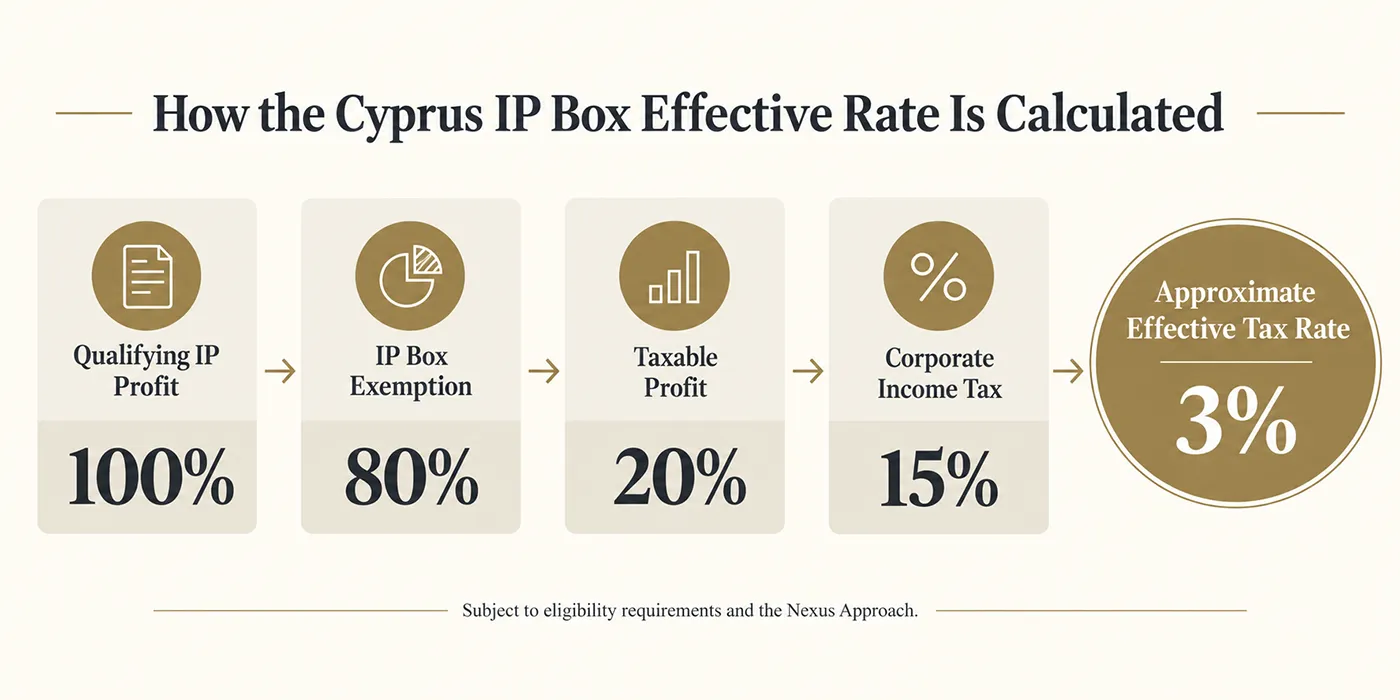
Say your business makes €100,000 in net IP profits and has a 100% nexus ratio. Here is what that would look like:
Calculation | Amount |
|---|---|
Net IP profits before the deduction | €100,000 |
IP Box deduction of 80% | −€80,000 |
Profits left subject to tax | €20,000 |
Corporate tax at 15% | €3,000 |
Effective tax rate | 3% |
In this example, the tax on €100,000 of net IP profits comes to €3,000. It assumes all those profits come from eligible IP, qualify for the full deduction and need no other tax adjustments. A lower nexus ratio would mean less relief, while any profits outside the regime would be taxed under the usual rules.
How Does Cyprus Compare with Other EU IP Tax Regimes?
If you’re comparing locations for your software or technology business, the tax rate is a useful starting point. The Netherlands’ Innovation Box applies a 9% effective rate to qualifying innovation profits, while Ireland’s Knowledge Development Box applies a 10% effective rate to qualifying profits.
Cyprus offers an effective rate as low as 3% on qualifying net IP profits where the full deduction is available. Each regime has its own eligibility rules and calculation requirements, so the headline rates alone do not tell you what your business would pay.
Who Qualifies for the Cyprus IP Box?
If your business earns profits from software, patents or other qualifying intellectual property, you may be able to benefit from the Cyprus IP Box. A review of the Cyprus IP Box regime starts with the company’s ownership of the IP, its development history and the income it earns.
To establish whether you qualify, we look at three things: who owns the IP, how it was developed and which profits come from it. The research and development costs behind the asset help determine how much relief you can claim, and you will need records to support the calculation.
Eligible Businesses and IP Ownership
The Cyprus IP Box applies to eligible profits earned by a Cyprus tax-resident company, provided the relevant conditions are met. The regime is also available to other Cyprus tax residents, Cyprus permanent establishments of non-resident taxpayers and foreign permanent establishments whose profits are subject to tax in Cyprus.
For software businesses, ownership is often the first thing to sort out. You may have written the original code yourself, hired developers or brought existing software into the business. In each case, it needs to be clear who owns the rights.
IP owners may qualify through legal or economic ownership, provided the relevant conditions are met.
The contracts and day-to-day arrangements need to support that position, whether through employment contracts, agreements with developers, IP assignments or licences.
If you developed your software before setting up the Cyprus company, it does not automatically belong to the company. You will need to review the existing ownership and arrange any necessary transfer. This also applies if another business owns the software.
We usually start by asking who owns the code, who does the development work and who pays for it. We then look at which company receives the software income.
These details matter. Selling subscriptions to software your company owns is different from being paid to build an application that belongs to your client. Understanding that relationship helps establish whether the IP Box could apply to your business.
Qualifying Intellectual Property Assets
Software and patents are among the main qualifying IP assets covered by the Cyprus IP Box, making the relief particularly relevant to businesses developing these forms of intellectual property.
Software includes software used in SaaS platforms, apps, AI products and video games.
The table below explains which assets can be treated as qualifying IP assets and what you need to check for each.
Asset | Can it qualify? | What to check |
|---|---|---|
Copyrighted computer software | Yes, if the requirements are met | Who owns the software, how it was developed and the qualifying R&D costs involved. A software patent is not required. |
Patents | Yes, if the requirements are met | The invention’s protection under the applicable patent legislation, its ownership and the R&D expenditure behind it. |
Utility models and extensions of patent protection | Yes, if the requirements are met | The legal protection in place, ownership and relevant R&D expenditure. |
Rights protecting plants and genetic material; orphan drug designations | May qualify | Whether the specific right is one of the categories covered by the legislation. |
Other non-obvious, useful and novel IP | May qualify, with additional conditions | Legal protection, certification by a competent authority in Cyprus or abroad, and the financial limits explained below. |
Trademarks, brands, business names and image rights | No | These are marketing-related assets, which fall outside the regime. |
Owning qualifying IP assets does not automatically give you the full deduction. You also need to establish ownership and review the development costs. The nexus calculation then determines how much of the profit can benefit from relief.
There are extra conditions for “other non-obvious, useful and novel IP”. To qualify under this category:
Your annual gross income from all IP assets must not exceed €7.5 million.
If your business belongs to a group, the group’s worldwide turnover must not exceed €50 million.
Both figures are assessed using five-year averages. These financial limits apply only to this category, rather than to qualifying software or patents generally.
Intellectual Property That Does Not Qualify
Trademarks, brands, business names and image rights do not qualify for the Cyprus IP Box. This remains the case even if they are registered, generate licensing income or represent a valuable part of your business.
Your company can, however, own both qualifying assets and assets excluded from relief. For example, your company’s software may qualify even though the brand used to market it does not. Each asset and the profits linked to it therefore need to be considered separately.

Cyprus IP Box for Software, SaaS and Technology Companies
If your business earns money from software, the Cyprus IP Box regime is worth exploring. Software used in SaaS platforms, mobile apps, games and other products may fall within qualifying IP assets, depending on what your company owns and how the software was developed.
The way you earn that income matters too. Customers might pay for access to your product, a software licence or a package that includes both software and services. Here’s how some common business models fit.
SaaS Platforms and Subscription Software
If customers pay a subscription to use software your company owns and develops, the profits attributable to that software may qualify for the IP Box. Customers do not need to receive your source code.
A subscription sometimes covers more than access to the product. You might also offer installation, training or consultancy. When everything is included in one price, you need a reasonable way to allocate the income and related costs between the software and those services, with records supporting the figures.
For example: Your company develops an online accounting platform and charges a monthly subscription. Profits from the qualifying software may benefit from the IP Box, with the deduction depending on the nexus calculation. If you also provide bookkeeping or advisory services, that income needs to be assessed separately.
AI Software, Mobile Applications and Video Games
The IP Box can apply to software behind AI applications, mobile apps and video games. What matters is identifying the software your business owns, the development spending behind it and the profits it generates.
AI software: You build a document-analysis application using your own code and a third-party AI model. The review would look at the software you own, the model’s licence terms and your development expenditure. Using another provider’s model does not, by itself, give your company ownership of qualifying IP.
Mobile applications: Your company develops and owns a productivity app. Profits from paid downloads or subscriptions may qualify, depending on ownership, R&D expenditure and the nexus calculation.
Video games: Your studio develops and sells its own game. Profits attributable to the game software may qualify. Income from merchandise, branding or other rights needs a separate review.
If founders, employees and freelance developers have all contributed to your product, check that their agreements clearly establish who owns the work. Addressing this early can make future investment discussions, licensing arrangements and a possible sale easier to manage. Our guide to software intellectual property protection explains what to consider.
Software Development Agencies and Mixed Business Models
For a development agency, writing software is only part of the picture. Who owns the finished product makes a difference.
If your client owns the software and pays you to develop it, those fees do not automatically qualify for the IP Box. Your agency may, however, also earn income from a product it owns and licenses to customers.
For example: Your company builds bespoke websites for clients and sells subscriptions to its own project-management app. Profits from the app may qualify. The website-development fees need to be considered separately.
Having both activities within the same company does not rule out relief. You will need records that distinguish the income and costs of each, so the qualifying profits can be calculated.
At Meridian Trust, we can help you understand which parts of your business may qualify and what agreements and records you need to support a claim. If you’re planning a new venture, explore our guide to starting a software company. For ongoing legal, corporate, tax and accounting support, our dedicated team is available through Ignite, Meridian’s Technology & Start-up Desk.
Which Income Can Benefit from the IP Box?
You don’t have to earn royalties to benefit from the Cyprus IP Box. Customers might pay a monthly subscription to use your software, buy a licence or purchase a product that incorporates your patented technology. Profits from these activities may qualify. The Cyprus IP Box regime looks at the profit your business earns from eligible IP, not simply how a customer payment is described.
The relief applies to the part of your profit that comes from qualifying IP. To work that out, you identify qualifying income, deduct the associated expenses and apply the nexus ratio, which links the deduction to your qualifying R&D expenditure.
If your company has several revenue streams, we can help you identify qualifying IP income, establish which profits may qualify for relief and explain what records you need to support the calculation.
Royalties and Software Licensing Income
IP owners might license their software to an enterprise customer or allow a manufacturer to use a patented invention.
For example, you might license your software to an enterprise customer or allow a manufacturer to use technology you have patented. The agreement needs to show which rights you are granting and how the income derived from licensing relates to the IP your company owns.
Licensing between companies in the same group also needs attention to pricing. The terms should reflect what independent businesses would agree. This is known as the arm’s-length principle.
Embedded IP Income in Products and Services
Your invoices don’t need to show a separate royalty charge. Sometimes customers pay for access to a product or service, and the income from your IP is included in that price.
A SaaS subscription is a familiar example. A customer pays to use your platform, rather than paying a separately labelled software royalty. Equipment incorporating a patented invention can work in a similar way.
This is called embedded IP income. The calculation identifies how much of the profit comes from the qualifying IP, with records explaining how that amount was determined.
Income stream | Example | What we need to establish |
|---|---|---|
Royalties and licence fees | A customer licenses your software or patent. | Which IP is licensed, who owns it and the net income it earns. |
Software subscriptions | Customers pay monthly to use your SaaS platform. | How much income relates to the software and whether the subscription includes other services. |
IP included in products or services | You sell equipment that uses a patented invention. | The share of profit attributable to the qualifying IP. |
Consultancy, implementation and support fees | You provide training, installation or advice. | Whether any income is attributable to qualifying IP. Owning software does not automatically make separate service profits eligible. |
Insurance or compensation payments | Your company receives compensation relating to qualifying IP. | What the payment covers and how it relates to the asset. |
Trading profits from selling IP | You sell software rights in a transaction treated as trading. | The nature of the sale, the profit after relevant expenses and the applicable nexus ratio. |
Capital gains from selling IP | You sell qualifying IP in a disposal treated as capital. | The separate capital treatment. These gains are outside the 80% deduction calculation. |
Separating IP Income from Consultancy, Support and Other Revenue
Your company can earn qualifying IP income from software alongside fees for consultancy or other services. You don’t have to choose one business model to benefit from the IP Box.
You do, however, need records that distinguish qualifying income from other revenue and show the costs associated with each activity. Where expenses are shared, they should be allocated on a reasonable basis and supported by records. An invoice description alone does not decide whether the income qualifies.
Here’s an example. Your company earns €500,000 in net profits:
€300,000 from qualifying software.
€200,000 from unrelated consultancy.
Assuming a 100% nexus ratio, the 80% deduction applies to the €300,000 software profit. That gives a €240,000 deduction, leaving €60,000 of software profit taxable.
Add the €200,000 consultancy profit, and the company has €260,000 in taxable profits before any other adjustments. At the 15% corporate tax rate, the tax would be €39,000.
The software profit benefits from an effective 3% rate in this example. The consultancy profit is taxed at the standard corporate tax rate.
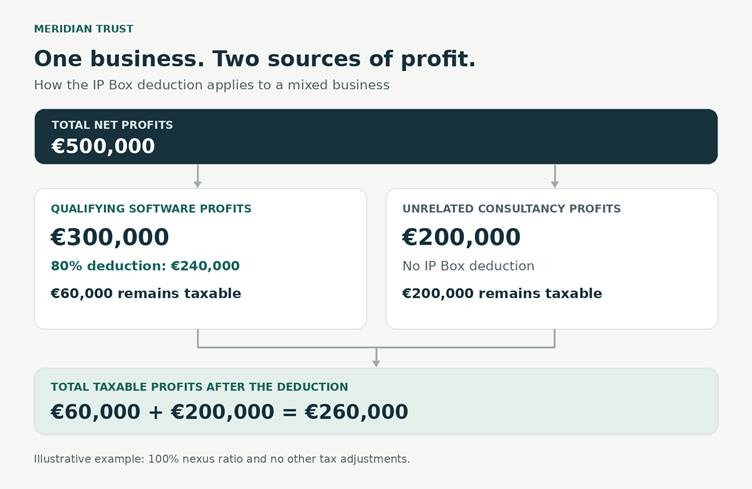
At Meridian Trust, we can help you put these figures together using your actual income and development costs. You can then see what the relief could mean for your business and understand the records needed to support your claim.
How Are Profits from Selling IP Treated?
If you’re considering selling your software or other qualifying IP, it helps to understand the tax treatment before agreeing the terms.
Where the sale is treated as a trading transaction, the profit may qualify for the IP Box deduction, after relevant expenses and the nexus calculation.
Where the disposal is capital in nature, gains from qualifying IP are generally exempt from Cyprus income tax. They are dealt with separately from the IP Box deduction, rather than being taxed at the 3% effective rate.
The distinction depends on the circumstances, including the asset’s role in your business. Selling it only once does not automatically make the disposal capital in nature. The profit or gain also needs to be distinguished from the total price the buyer pays.
We can review a proposed sale with you while it is still being planned, so you understand the expected tax position before committing.

Photo by Mikhail Nilov
How Is Cyprus IP Box Tax Calculated?
Once we have confirmed which qualifying assets your company owns, the next step is to calculate the tax saving available under this IP regime.
To apply the Cyprus IP Box regime, we start with the net profit your IP generates, after relevant expenses. We then apply your nexus ratio, which reflects the expenditure behind developing or acquiring the IP. This determines how much of that profit receives the 80% deduction.
The deduction is subtracted from your net IP profit, and the remaining taxable profit is taxed at 15%. With a 100% nexus ratio, this gives an effective tax rate of 3%. If you are also exploring notional tax deductions, such as Cyprus’s Notional Interest Deduction on eligible new equity, these need a separate assessment. They are distinct from the IP Box deduction and have their own conditions.
The Nexus Approach Explained Simply
Under this IP regime, the nexus approach links your tax relief to the spending behind your IP. To calculate it, we need to distinguish between spending on your own research and development activities, work outsourced to independent developers, IP acquisition costs and development carried out by related companies.
The modified nexus approach is required under the OECD’s Base Erosion and Profit Shifting (BEPS) Action 5 standard for preferential IP regimes. The Cyprus IP Box regime follows this standard, linking the relief to qualifying R&D expenditure rather than simply to ownership of intellectual property.
The formula is:
Nexus ratio = (Qualifying expenditure + Uplift) ÷ Overall expenditure
We then use that ratio to calculate the deduction:
Qualifying IP profits = Net IP income × Nexus ratio
IP Box deduction = Qualifying IP profits × 80%
A 100% nexus ratio means the deduction applies to all your eligible net IP income. At 65%, the deduction applies to 65% of that income. This does not change the eligibility of the IP itself; it changes the amount of relief available on its profits.
The ratio cannot exceed 100%. It uses expenditure accumulated over the asset’s life, rather than just the current year’s development costs, and is applied to the net IP income for the year being assessed.
Qualifying Expenditure, Overall Expenditure and the Uplift
Each cost needs to go into the right category before the ratio can be calculated.
Component | What it includes |
|---|---|
Qualifying expenditure (QE) | R&D spending directly connected with creating, developing or improving the qualifying IP. This can include relevant employee costs and R&D outsourced to unrelated parties. |
Overall expenditure (OE) | Qualifying expenditure, plus the cost of acquiring the IP and R&D outsourced to related parties, such as another company in your group. |
Uplift expenditure (UE) | The lower of 30% of qualifying expenditure or the combined cost of IP acquisition and R&D outsourced to related parties. |
Acquisition costs and related-party outsourced R&D increase overall expenditure without counting directly as qualifying expenditure. The uplift allows a limited adjustment for those costs when calculating the ratio.
It is a calculation adjustment, not an extra expense you need to incur or a separate 30% tax deduction. If there are no acquisition or related-party outsourced R&D costs, the uplift is zero.
Interest, property acquisition or construction costs, and expenditure without the required connection to the IP asset are excluded from qualifying expenditure.
If your product has been developed over several years or by different teams, we can help you bring those records together, review the costs incurred and explain how each cost affects your IP Box benefit.
Worked Examples of IP Box Tax Savings
The following examples show how development expenditure and different sources of income affect your IP Box benefit and final tax bill, helping you assess what the relief could mean for your company’s tax efficiency.
Each starts with annual net profit after relevant expenses and applicable capital allowances, but before the IP Box deduction. The historical expenditure figures establish the nexus ratio; they are not deducted again from that profit.
All three examples assume eligible IP, adequate supporting records, a 15% corporate tax rate and no other reliefs or adjustments.
Example 1: A software business with a full nexus ratio
A company earns €500,000 in annual net profit, entirely from eligible software.
Its cumulative qualifying R&D expenditure is €200,000. It has no IP acquisition costs or R&D outsourced to related parties, so the uplift is zero.
Nexus ratio: (€200,000 + €0) ÷ €200,000 = 100%
Calculation | Amount |
|---|---|
Net IP profit before the deduction | €500,000 |
Qualifying IP profits: €500,000 × 100% | €500,000 |
IP Box deduction: €500,000 × 80% | €400,000 |
Remaining taxable profit | €100,000 |
Corporate tax: €100,000 × 15% | €15,000 |
Effective tax rate | 3% |
Tax saving compared with €75,000 without IP Box relief | €60,000 |
The company deducts €400,000 and pays tax on the remaining €100,000. This delivers significant tax benefits in this example: its tax bill falls from €75,000 to €15,000.
Example 2: A business with acquisition and related-party development costs
This company also earns €500,000 in annual net profit, entirely from eligible IP. Its cumulative expenditure includes:
€200,000 of qualifying R&D expenditure.
€100,000 spent acquiring the IP.
€100,000 of R&D outsourced to a related company.
Overall expenditure is €400,000.
The uplift is the lower of €60,000—30% of qualifying expenditure—and €200,000 of acquisition and related-party R&D costs. We therefore use €60,000.
Nexus ratio: (€200,000 + €60,000) ÷ €400,000 = 65%
Calculation | Amount |
|---|---|
Net IP profit before the deduction | €500,000 |
Qualifying IP profits: €500,000 × 65% | €325,000 |
IP Box deduction: €325,000 × 80% | €260,000 |
Remaining taxable profit: €500,000 − €260,000 | €240,000 |
Corporate tax: €240,000 × 15% | €36,000 |
Effective tax rate | 7.2% |
Tax saving compared with €75,000 without IP Box relief | €39,000 |
All the profit comes from eligible IP. However, the expenditure history produces a 65% nexus ratio, so the 80% deduction applies to €325,000 rather than the full €500,000. The company still saves €39,000.
Example 3: A business earning software and consultancy profits
A company earns €500,000 in annual net profit:
€300,000 from eligible software.
€200,000 from standalone consultancy services outside the IP Box.
The software has €200,000 of cumulative qualifying R&D expenditure and no acquisition or related-party outsourced R&D costs. Its nexus ratio is therefore 100%.
Calculation | Amount |
|---|---|
Total net profit before the deduction | €500,000 |
Qualifying software profits | €300,000 |
IP Box deduction: €300,000 × 80% | €240,000 |
Remaining taxable software profit | €60,000 |
Taxable consultancy profit | €200,000 |
Total taxable profit | €260,000 |
Corporate tax: €260,000 × 15% | €39,000 |
Overall effective tax rate | 7.8% |
Tax saving compared with €75,000 without IP Box relief | €36,000 |
The software profits benefit from an effective 3% tax rate. The consultancy profits are taxed at 15%, giving the company a combined effective rate of 7.8%.
At Meridian Trust, we can work through the calculation using your company’s figures, explain the expected saving and help you maintain the records supporting your claim.
IP Ownership, R&D and Substance Requirements
Before claiming the IP Box deduction, your company needs to be able to show what it owns, what it has spent on development and how the IP earns its income.
For an established software business, records of IP development and the ownership of existing IP may be spread across developer contracts, payroll, invoices and agreements signed when the product was first created. Bringing it together helps establish the claim and can reveal ownership issues that are easier to resolve early.
There are also separate questions about where the company is tax resident, how it is run and its dealings with other companies in the same group. The nexus calculation does not settle those questions.
Documenting Ownership of Software and Other Intellectual Property
Start with the ownership history of your IP assets. Who created them, and how did the company acquire its rights?
With software, the answer often involves more than one person. A founder may have written the original code, employees developed later versions and freelancers added particular features. The company should have agreements supporting its legal or economic ownership of the work.
Code written before incorporation deserves a closer look.
Setting up a company does not automatically make it the owner of software you developed beforehand. The existing rights need to be reviewed and any necessary transfer documented, taking account of valuation and the tax consequences for both parties.
For external developers, check what the contract actually says. Does your company own the deliverables? Can it change the software and sell or license it? Has the developer retained rights, or used third-party components with their own licence restrictions?
An invoice confirms a payment. It does not, on its own, establish that all the rights your company needs have transferred.
We can review the agreements you already have and help address any gaps in that ownership history.
Employees, Overseas Developers and Outsourced R&D
Working with developers abroad does not automatically prevent you from claiming IP Box relief. Your whole development team does not have to be based in Cyprus.
For the nexus calculation, the treatment depends on who incurs the expenditure, what work it relates to and whether an outsourced developer is independent or connected to your company.
Your own R&D: Relevant employee costs and other directly connected development expenditure may count as qualifying expenditure.
Independent developers: Qualifying R&D outsourced to unrelated providers may also count, including work carried out overseas.
Group companies: R&D outsourced to a related company goes into overall expenditure rather than qualifying expenditure, with the permitted uplift taken into account.
Location is therefore only part of the picture. Overseas working arrangements may also bring tax or employment obligations that need their own review.
It helps to record the costs incurred while development is under way. Keep project descriptions, payroll and invoices, along with details of each developer’s responsibilities, so you can trace direct costs to the relevant development work. Time allocations, where appropriate, and version-control or release records can help connect the costs to the work.
The records should make it possible to follow what was developed, which asset it belongs to and how qualifying R&D was distinguished from other activities.
Cyprus Management, Substance and Transfer Pricing
Tax residence: Cyprus rules recognise management and control in Cyprus and an incorporation-based test, subject to the applicable treaty exception. Residence should therefore be reviewed alongside where strategic decisions are actually made and whether another country could also claim taxing rights.
Commercial substance: The company’s people, resources and decision-making should support the functions and risks attributed to it. Relevant questions include who approves development budgets, selects and supervises developers, controls product strategy and negotiates significant contracts. Board minutes should record genuine decisions and oversight.
Transfer pricing: Transactions with related parties—including IP transfers, licences and development services—must be assessed on arm’s-length terms. The analysis considers who develops, enhances, maintains, protects and exploits the IP, commonly described as DEMPE, and who controls the associated risks. Legal ownership alone does not establish entitlement to all IP returns.
A development fee can be correctly priced for transfer-pricing purposes while still being excluded from qualifying expenditure in the nexus numerator. Equally, a full nexus ratio does not establish tax residence or resolve how profits should be allocated between group companies.
Meridian Trust reviews these issues together, helping clients align IP ownership, development agreements, governance and accounting records with the way their business actually operates.
How to Set Up and Claim the Cyprus IP Box
You claim the Cyprus IP Box deduction through your company’s annual corporate income tax return. Before making the first claim, you need to establish that the IP qualifies, calculate the deduction and have the records to support it. Records should show how the company meets the conditions of the Cyprus IP Box regime and how it calculated the deduction.
You may already have much of what is needed. An existing Cyprus company can use this IP regime if it meets the conditions; setting up a separate IP company is not automatically necessary.
At Meridian Trust, we work through the following steps with you.
1. Understand your business and the IP behind it
We begin with your product: what it does, how it earns income and how it was developed.
This includes looking at code written by founders, contributions from employees and external developers, and any software or rights you have acquired. The review establishes which of your software products or other rights are qualifying assets and identifies any missing agreements or records.
2. Check whether your existing company is suitable
If you already have a Cyprus company, we review its tax residence, activities, ownership arrangements and how it operates. It may be possible to claim through that company.
Where a new structure is appropriate, we consider the legal and tax implications before you transfer IP or change your contracts.
3. Put the ownership and development agreements in place
Your company needs documented rights to use and commercially exploit the IP.
Depending on what is already in place, this may involve founder assignments, employment provisions, developer agreements or licences. The documents should reflect who does the work, who pays for it and who controls the relevant risks.
4. Calculate the deduction
We identify qualifying IP income and the expenses attributable to it, keeping both separate from your other business activities.
We then review the cumulative development expenditure, calculate the nexus ratio and work out the annual deduction. The accounting records need to support those figures, show how direct costs and shared expenses have been allocated, and allow the calculation to be updated each year.
5. Decide whether a tax ruling would be useful
An advance tax ruling is not generally required. It can, however, be useful if an important question about your proposed claim or structure needs clarification.
Where a ruling is appropriate, we prepare a request explaining the facts, relevant agreements, proposed tax treatment and the specific questions for the Cyprus Tax Department.
6. Include the deduction in the annual return
The deduction is included in your company’s annual tax calculation and corporate income tax return.
Each year, the figures need updating. Changes to IP ownership, development arrangements, revenue or transactions with group companies should also be reviewed, as they may affect the claim.
Is an Advance Tax Ruling Required?
No—an advance tax ruling is not a general requirement for claiming the Cyprus IP Box. A company that meets the conditions and can support its claim can include the deduction in its annual tax return without prior administrative approval.
Any certification required for a particular category of IP must still be obtained.
A ruling serves a different purpose. It allows you to ask the Tax Department for written clarification on a specific tax question. For example, you may want confirmation about an asset’s eligibility, income included in a wider product or service, or the treatment of a proposed structure.
The distinction is:
Your annual tax return is where you claim the deduction for that year.
A ruling request asks the Tax Department to clarify the treatment of the facts and questions you present.
Even with a favourable ruling, you still need annual calculations and supporting records. If the business arrangements or the law change, you should check whether the ruling still applies.
We can explain whether a ruling would add useful clarity in your circumstances and what the request would need to cover.
What Documents Will You Need?
The documents depend on your business and its development history. The table below gives you an idea of what we would usually review.
Area | Documents and information |
|---|---|
Business and structure | Company details, group structure, an explanation of the business model, and relevant tax-residence and governance records. |
IP and ownership | Descriptions of the IP assets, relevant registrations or certificates, founder assignments, acquisition agreements and licences. |
Development arrangements | Employment and contractor agreements, development history, project records and evidence of the work carried out. |
R&D expenditure | Payroll, supplier invoices, cost allocations and details showing which developers are independent and which are related parties. |
Income and calculations | Customer contracts, revenue breakdowns, attributable expenses, cumulative nexus calculations and annual tax computations. |
Other supporting documents, where relevant | Valuations, transfer-pricing documentation, tax rulings and related correspondence. |
These documents support your claim; they are not all automatically submitted with every tax return.
You do not need to organise everything before speaking with us. We can start by reviewing what you have, explain what else is needed and help you prepare for the first claim. Meridian Trust coordinates the ownership, structuring, accounting and tax work, with ongoing support for the annual calculations and filing.
Cyprus IP Box Setup Costs and Timeline
The work involved depends on where your business is today. You may already have a Cyprus company, signed developer agreements and well-organised records. Or you may need to set up the company and arrange ownership of software you developed as a founder.
Before we begin, we review what is already in place and explain what your business needs to do to use this IP tax regime. You receive a quotation covering the initial work and the ongoing services, so you can budget for both.
What Affects the Implementation Timeline?
If you need a new Cyprus company, incorporation typically takes 5–7 working days through the express service, or around 3–4 weeks through the normal service, after the incorporation documents are submitted to the Registrar. Name approval, onboarding checks and agreement on the company structure come before submission.
Incorporation is one stage of the process. Preparing for your IP Box claim also involves checking eligibility, confirming ownership and organising the development and accounting records.
How long that takes will depend mainly on:
Who currently owns the IP. Software created by a founder or acquired from another business may need an assignment, a valuation or a review of earlier agreements.
The development records available. Payroll, developer contracts, invoices and project records help us establish the expenditure used in your nexus calculation.
How the business earns its income. Several products, bundled services or transactions between group companies can take more time to assess.
Any outside input needed. A specialist valuation, advice from another country or a tax ruling will have its own timetable.
Some of this work can take place while the company is being incorporated. After the initial review, we set out the stages, the information we need from you and an estimated timetable.
If we recommend requesting a tax ruling, we explain the preparation work and allow separately for the Tax Department’s response time.
Initial Advisory Costs and Ongoing Compliance Fees
Your quotation shows what is included in getting the arrangements in place and what you can expect to pay for ongoing support.
Service | What the fees cover |
|---|---|
Company formation, if needed | Incorporation and the corporate services you choose. We identify any additional registrations, banking assistance or operational requirements separately. |
IP eligibility and structuring review | Reviewing your IP, business model, ownership and development history. The scope depends on the assets, companies and countries involved. |
IP and development agreements | Preparing or reviewing the assignments, licences, employment provisions and contractor agreements your business needs. |
Advance tax ruling, where appropriate | Preparing the request and handling the agreed correspondence with the Tax Department. Government charges are shown separately. |
Accounting and annual IP Box compliance | Bookkeeping, allocation of income and costs, annual nexus calculations, tax computations and return preparation, as agreed in your engagement. |
Other ongoing support | Corporate administration, VAT, payroll, financial reporting and audit coordination, where needed. Valuations and transfer-pricing work are quoted separately when required. |
Ongoing fees reflect the work your business needs each year. Transaction volumes, employee numbers, reporting requirements and the number of IP assets all affect the scope, as does the complexity of the calculations.
The initial assessment helps us identify whether your business may qualify, what information is missing and whether ownership documents, specialist advice or a ruling need attention. We then agree the scope and fees for the detailed analysis and implementation.
Your quotation sets out the deliverables, how the fees are calculated, applicable VAT and any government or third-party charges. Any exclusions are explained before work begins.
If you also need to establish a company, you can read more about our Cyprus company formation services.
Why Choose Meridian Trust for Cyprus IP Box Advice?
Meridian Trust brings together legal, corporate, tax and accounting support for businesses developing and commercialising intellectual property. Our work connects the initial eligibility assessment with the ownership arrangements, development records and annual calculations needed to support an IP Box claim.
A Dedicated Team for Technology and Software Businesses
We work with software developers, technology companies, gaming businesses and start-ups. Our dedicated technology and software team considers how your product is developed, who owns it, how customers pay for it and how the business intends to grow.
You have a dedicated point of contact coordinating the work across the relevant professionals, with responsibilities defined in the agreed engagement.
Coordinated Legal, Corporate, Tax and Accounting Support
An IP Box structure needs consistent legal documentation, tax analysis and financial records. Meridian coordinates these elements through the same client relationship.
Area | Meridian’s role |
|---|---|
Eligibility and structuring | Review the business model, IP ownership and development arrangements; identify the technical questions requiring assessment. |
Legal documentation | Prepare or review IP assignments, licences, employment provisions and development agreements within the agreed scope. |
Company formation and administration | Establish the company where required and support its corporate records, governance and ongoing administration. |
Accounting and IP Box compliance | Organise income and expenditure records, prepare nexus calculations and coordinate the annual tax computation and return. |
Specialist input | Coordinate external valuation, transfer-pricing, overseas legal or tax advice where the engagement requires additional expertise. |
The engagement distinguishes work undertaken by Meridian’s team from work requiring external specialists. Where independent audit or other specialist assurance is required, this is coordinated separately.
Practical Experience with IP Box Structures
Our IP Box services cover company formation, IP ownership and R&D structuring, documentation and ongoing compliance. We assess how these elements fit the particular business, including existing software, outsourced development, related-party arrangements and mixed income streams.
The purpose of the assessment is to establish which profits may qualify, what evidence supports the position and what work is needed before a claim is made.
Our support continues after setup.
As part of the agreed annual engagement, the team updates the nexus calculation, reviews income and cost allocations, and considers changes to IP ownership, development arrangements or group transactions. Where a ruling has been obtained, material changes are reviewed against the facts on which it was issued.
This continuing relationship helps keep the legal arrangements, accounting records and tax position aligned as the business develops.
Frequently Asked Questions
Can a Small or Founder-Owned Software Company Qualify?
Yes. You do not need a large team or belong to an international technology group to use the Cyprus IP Box.
A founder-owned company can qualify if it owns eligible software, earns profits from it and meets the R&D nexus requirements. You will still need agreements and records supporting ownership, development spending and the amount claimed.
Can I Use the IP Box for Software Developed Before the Cyprus Company Existed?
It may be possible. If you started developing the software before setting up your company, we first need to establish how the company acquires the rights to it.
Transferring the software does not automatically mean your earlier personal development spending becomes the company’s qualifying R&D expenditure. We review the transfer, valuation and development history together with any further development the company funds.
Does Purchasing Existing Software Qualify the Company for Relief?
Buying software does not, by itself, qualify your company for IP Box relief.
The purchase price counts towards overall expenditure in the nexus calculation, but it is not qualifying R&D expenditure. If your company carries out further qualifying development, relief may be available on the resulting IP profits. The amount will depend on the balance between acquisition costs and qualifying development spending, alongside the other conditions.
Can My Developers Work Outside Cyprus?
Yes. Your developers do not all have to be based in Cyprus.
Qualifying R&D outsourced to independent developers can count towards qualifying expenditure, including when they work overseas. Work outsourced to another company in your group is treated differently in the nexus calculation.
You will need agreements establishing ownership and records showing the work performed and its cost. Overseas arrangements should also be checked for any local tax or employment obligations.
Do I Personally Need to Relocate to Cyprus?
No. You do not generally need to move to Cyprus as a shareholder for your company to claim IP Box relief. The company must meet the requirements in its own right.
Where you manage the business does matter, though. Running it from another country can affect the company’s tax residence or create a taxable business presence there. We can review your personal residence and the company’s management arrangements together, so you understand the position before making changes.
Can an Existing Cyprus Company Use the Regime?
Yes. You may be able to use your existing Cyprus company without setting up a separate IP holding company.
We would review its IP, income and development records to establish eligibility and calculate the deduction. Any gaps in ownership documents or developer agreements would also need attention before the claim.
How Are IP Box Losses Treated?
If the qualifying IP calculation produces a loss, generally only 20% of that qualifying loss is available to carry forward or use for group relief, subject to the relevant conditions.
This rule applies to the qualifying IP loss. It does not mean that every loss or expense in a software company is restricted to 20%. Losses from other business activities need to be considered separately.
Does the IP Box Affect VAT or My Personal Dividend Taxation?
The IP Box reduces your company’s corporate income tax on qualifying IP profits. It does not reduce VAT or remove any VAT registration, invoicing or reporting obligations.
Your personal tax position is separate. When the company pays you dividends, the treatment depends on your tax residence, applicable domicile rules and any other relevant requirements, including healthcare contributions.
Cyprus Non-Dom status needs its own assessment. An IP Box claim by your company does not automatically make the dividends you receive tax-free.
For more insights on intellectual property, explore our related articles:
- Safeguarding Innovation: Comprehensive Software Intellectual Property Protection
- The Role of Intellectual Property (IP) in Attracting Venture Capital Investments
- Leveraging AI for Intellectual Property Management: Protecting and Maximizing IP Value
- Cyprus IP Box and SaaS Software Sales Tax: A Winning Strategy
- Offshore Tax Planning for SaaS and Software Companies: Leveraging Cyprus for IP Optimization